

The United States has imposed sanctions on 8 Canadian money services businesses for facilitating financial restrictions evasions by Iranian entities via currency exchanges and crypto transactions. The sanctions were announced by the Department of the Treasury as part of Operation Economic Outcast and target businesses in Ontario and British Columbia that are allegedly exchanging Iranian rials into digital assets.
The Treasury also linked several businesses to cryptocurrency wallets linked to Iran’s Islamic Revolutionary Guard Corps (IRGC) and alleged drug money laundering activities involving Canadian trafficker Ryan Wedding.
Why the U.S. Sanctioned Canadian Crypto Firms
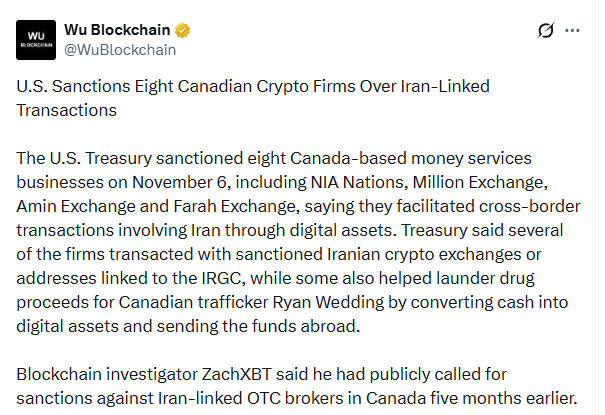
Eight businesses were designated by the Treasury’s Office Of Foreign Assets Control (OFAC) for allegedly providing support to Iran’s digital assets industry and financial transactions with sanctioned entities.
Source: Wu Blockchain
According to the department, the companies converted Iranian rials and other currencies into digital assets, enabling international transfers involving Iran. Some allegedly conducted transactions with sanctioned Iranian cryptocurrency exchanges and digital asset addresses associated with the IRGC.
Treasury Secretary Scott Bessent said the United States would pursue financial networks supporting Iran beyond its borders. He warned against Canada becoming a safe haven for businesses providing sanctions evasion services to the Iranian government and its proxies.
The designations were imposed under Executive Order 13902, which targets Iran’s digital asset sector and other important areas of its economy.
The Eight Canadian Businesses Named by OFAC
The sanctioned entities include Diverse Trade Inc, operating as Million Exchange; 1380079 BC Limited and Top PC Technician Inc, associated with Amin Exchange; NIA Nations Currency Ltd, also known as NIA Nations; 2397639 Ontario Ltd, operating as Farah Exchange; CCC Inc; B Galaxy Inc, operating as Cryptoyal; and Darvish Exchange.
OFAC provided specific allegations against several businesses. Million Exchange allegedly facilitated transfers involving cryptocurrency addresses associated with the IRGC and converted cash connected to drug sales into digital assets.
Amin Exchange is accused of accepting digital assets from an Iranian exchange Shelbit that has been sanctioned plus laundering millions of dollars of alleged drug funds. NIA Nations is linked to activities around addresses connected to sanctioned exchanges like Nobitex, Wallex, Ramzinex and Bitpin.
Farah Exchange is also accused of interacting with Shelbit and Wallex and CCC Inc accepted digital assets from addresses linked to terrorism-related activities.Darvish Exchange was also linked to transactions involving sanctioned Iranian exchanges.
B Galaxy Inc, through Cryptoyal, advertised digital asset exchange services involving Iranian currencies.
Ryan Wedding Allegations Add a Drug Trafficking Dimension
The enforcement action also involved coordination with the U.S. Drug Enforcement Administration (DEA).
The Treasury linked several designated businesses to Ryan Wedding, a Canadian drug trafficker previously sanctioned by OFAC. According to the department, Wedding used exchange businesses in Vancouver and Toronto to launder drug proceeds.
The alleged process involved couriers delivering cash to exchange businesses, which converted the funds into digital assets before transferring them abroad.
Treasury said Wedding worked with several of the designated businesses to move millions of dollars in digital assets before his apprehension in January 2026.
MEXC Global Faces a Separate FinCEN Restriction
The Treasury has taken action against the Seychelles-based crypto exchange MEXC Global.
The Financial Crimes Enforcement Network (FinCEN) unit of the Treasury has issued an order stopping U.S. financial institutions from moving funds for MEXC.
FinCEN accused the exchange of facilitating at least $16 billion of illegal transactions using Iran, North Korea, Russia and other sanctioned countries.
MEXC was not one of eight Canadian businesses but is a separate case. The Financial Transactions and Reports Analysis Centre of Canada (FINTRAC) confirmed it had an agreement with the FinCEN.
“We regularly work with our counterparts in international financial intelligence units to address threats such as money laundering, terrorist financing and sanctions evasion,” said FINTRAC.
What the Sanctions Mean for the Businesses
The U.S. measures freeze assets held by the targeted businesses in the United States and bar dealings with U.S. individuals and entities. They also limit access to the dollar financial system.
This expands Operation Economic Outcast which was launched in August 2026 and seeks to disrupt financial flows that Washington claims are used to support the Iranian government and IRGC.
Previous actions targeted Iranian exchanges, including Nobitex, Wallex, Bitpin, Ramzinex, Aban Tether Exchange, and Shelbit.
FAQs
Why did the U.S. sanction eight Canadian crypto firms?
The eight canadian crypto firms are being accused of conducting transactions with sanctioned Iranian entities using currency and virtual assets.
Which Canadian companies have been sanctioned?
They include Million Exchange, two Amin Exchange-associated companies, NIA Nations, Farah Exchange, CCC Inc, B Galaxy Inc, and Darvish Exchange.
What is Operation Economic Outcast?
The action is part of an initiative by the U.S. Treasury back in August 2026 to disrupt financing that is alleged to be supporting the Iranian government and IRGC.
Was MEXC Global sanctioned by Canada?
No. FinCEN issued a separate order restricting U.S. financial institutions from processing transfers involving MEXC Global.
Conclusion
U.S. sanctions on Canadian crypto firms continue Operation Economic Outcast by targeting global financial intermediaries alleged to be helping evade Iranian sanctions.
It is part of a broader effort by Washington to target digital asset networks it believes are connected to sanctioned groups and illicit finance.