

- FinCEN has withdrawn the self-custody crypto wallet rules issued in 2020.
- FinCEN also withdraws crypto mixing rules issued in 2023 owing to wide reporting obligations.
- Banks and other regulated crypto firms will still be subject to existing AML and sanctions requirements.
The U.S. Treasury Department has rescinded two rules that would have required more reporting and validation of transactions carried out via self-hosted crypto wallets and crypto-mixers through international borders. The rescission of the two rules was stated by FinCEN, which is a division of the U.S. Treasury, on Oct. 5, and will be published in the Federal Register on Oct. 6.
One of the rules is dated 2020 and was related to transactions with convertible virtual currency stored in wallets that were not hosted by financial institutions.
The withdrawals mean the specific reporting frameworks outlined in the proposals will not move forward. Nevertheless, current regulations under the Bank Secrecy Act, anti-money laundering and sanctions, applicable to the activities of regulated financial institutions, still apply.
Self-Custody Crypto Wallet Rules Will Not Move Forward
The 2020 proposal would have placed additional duties on banks and money services businesses handling certain transactions involving what FinCEN called “unhosted wallets.” The proposal covered wallets controlled by customers themselves rather than hosted by a financial institution.
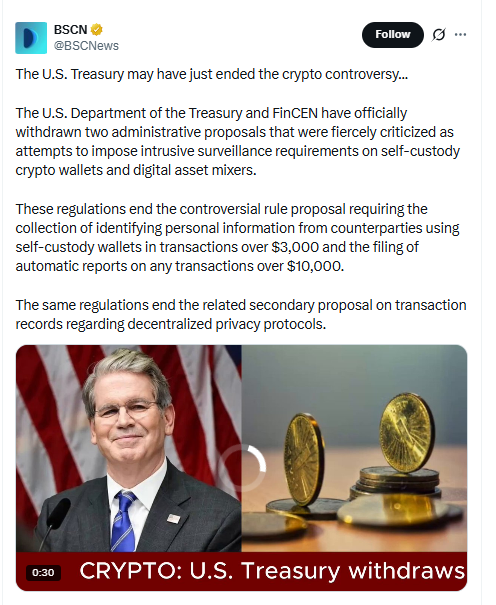
Source: BSCN News
The framework would have mandated that for some transactions exceeding $3,000, financial institutions would be required to gather and retain information and identify customers. Transactions exceeding $10,000 would result in reports being filed subject to certain conditions.
The $10,000 reporting threshold would also have applied when multiple transactions involving the same circumstances exceeded $10,000 over a 24-hour period.
The proposal was aimed at transactions involving a customer’s external wallet or a wallet hosted by a financial institution in certain foreign jurisdictions identified by FinCEN. It therefore focused on activity occurring partly outside the institution’s own system.
For financial institutions, the proposed requirements would have created additional procedures for identifying and documenting parties involved in external-wallet transfers. A regulated business can identify its own customer, but an external wallet may be controlled directly by a user rather than an exchange or another custodian.
FinCEN has now withdrawn the proposal. The agency said the withdrawals form part of the Trump administration’s deregulatory agenda and its efforts to ensure digital-asset regulations are fit for purpose.
| Proposal | Year | Area covered | Proposed requirement |
| Self-custody wallet rule | 2020 | Certain external-wallet transactions | Records and verification above $3,000 |
| Self-custody wallet rule | 2020 | Qualifying transactions | Reporting above $10,000 |
| Crypto mixing rule | 2023 | International CVC mixing | Special reporting measures |
Crypto Mixing Proposal Also Withdrawn
The second withdrawal concerns a 2023 proposal addressing convertible virtual currency mixing. It would have established a special measure for transactions involving mixing within or involving a foreign jurisdiction.
Covered financial institutions would have been required to report transactions they knew, suspected or had reason to suspect involved international crypto mixing.
The proposed reporting system could have required information about the amount and type of cryptocurrency involved, mixer and wallet details, transaction hashes, dates, IP addresses and descriptions of the activity. It also could have required identifying information about customers.
The proposal covered several methods associated with mixing, including pooling funds, algorithmically coordinating transactions, splitting transfers, using single-use wallets, exchanging digital assets, and delaying transactions.
FinCEN decided to withdraw the proposal after considering concerns that its broad definition could have a chilling effect on legitimate cryptocurrency activity and create a significant reporting burden for financial institutions.
Crypto Compliance Rules Remain Intact
The reversal of the self-hosted crypto wallet regulation does not mean the obligations of a licensed bank are void.
Moreover, risk assessment for inter-account transfers executed by the clients of crypto exchanges can be continued by the latter. The platform can require details about the transaction or suspend the operation that the platform finds suspicious.
Sanctions requirements also remain separate from the withdrawn proposals. The supplied material notes that platforms may still restrict transfers involving particular services or entities when sanctions or other compliance rules require action.
The same differentiation holds true for mixed transactions. The removal of the proposed reporting regime does not take away from any existing obligations that can compel companies to screen any suspicious activities and prevent prohibited transactions.
For users, the immediate change is therefore focused on what regulated firms will not have to implement under these two proposals. Self-custody wallets remain a way for users to control their own crypto, but transfers involving regulated businesses continue to be subject to the institutions’ existing legal and compliance obligations.
FAQs
What did FinCEN withdraw?
FinCEN withdrew its 2020 proposal concerning self-hosted wallets and its 2023 proposal concerning international cryptocurrency mixing.
What was the threshold in the 2020 wallet proposal?
Transfers exceeding $3,000 would be subject to record-keeping and client identification measures, whereas transfers above $10,000 would be reportable under this proposed rule.
What did the crypto mixing proposal require?
It would have required covered financial institutions to report detailed information about certain transactions they knew, suspected or had reason to suspect involved international crypto mixing.