
Introduction
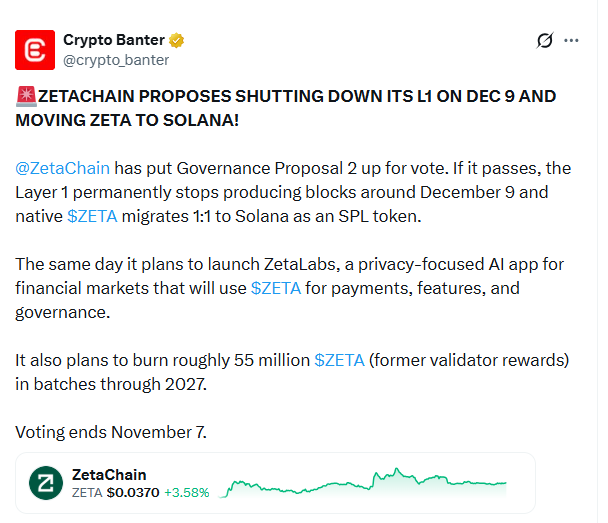
ZetaChain announced a new Governance Proposal (Proposal 2) for ZETA token migration from the current Layer 1 blockchain to Solana. This migration will occur on December 9, 2026.
The proposal was submitted on November 4 and contains details around the migration itself, how holders’ balances will be calculated, token issuance and validator emission changes. The transition also coincides with the planned launch of ZetaLabs, a private artificial intelligence application focused on financial research.
The submission follows Governance Proposal 68, which received 99.4% support in September and approved the direction of the transition. Proposal 2 provides the operational arrangements and establishes a 72-hour voting period scheduled to close November 7. The migration will proceed only if the proposal passes.
ZetaChain’s Solana Migration Creates a New Token Framework
Under Proposal 2, ZETA will function as an SPL token on Solana, which will keep the same ticker and a 1:1 exchange ratio. For the migration, a snapshot will be taken on a block height which is anticipated to be around December 9.
Source: Crypto Banter
The snapshot will include liquid holdings, staked balances, ZETA that is unbonding, and unclaimed rewards. The existing Layer 1 ZetaChain network will shut down at the same block height and will not continue further with this proposal.
Before claims open, the total eligible ZETA balance recorded during the snapshot will be minted on Solana. The mint authority will subsequently be revoked, preventing further token creation through that authority. The new token will have nine decimal places and no freeze authority.
The max supply of ZETA will be kept at 2.1 billion ZETA minus the burnt ZETA. Existing ZETA held on Ethereum as an ERC-20 token will remain unaffected by the migration.
Migration Process and Protections for ZETA Holders
ZetaChain plans to open its migration portal through ZetaHub on December 9. Holders will connect the wallet containing their ZETA, sign a message identifying a Solana wallet, and receive their corresponding balance after processing.
According to the proposal, claiming tokens will not require a transaction fee or SOL. The portal will also never request users’ seed phrases, with the process relying on a message signature rather than a transaction.
The migration portal and its underlying program are undergoing an independent security review by Hacken. ZetaChain states that the portal will open only after the review is completed and its report published.
Staked and unbonding balances, alongside eligible unclaimed rewards, will be included in the snapshot. Consequently, holders will not need to unstake their tokens before the transition. Exchange-held balances are scheduled for automatic crediting without individual claims.
ZETA Supply Changes and Validator Emissions
Proposal 2 introduces a different approach to undistributed validator emissions following the network transition. Approximately 55 million ZETA in emissions that would otherwise have been distributed are scheduled to be burned throughout 2027.
The system proposed requires 12 burns per month, each burn being approximately 4.6 million ZETA. The burns will be listed in the ZETA Dashboard, along with the number of tokens available and the amount of tokens that have been locked.
The staking rewards will be halted at the snapshot height, while the validator emissions will be burnt rather than rewarded. The current vesting system for purchasers and core contributors will be preserved until January 1, 2027.
Moreover, ZetaChain says there won’t be any new releases of ZETA tokens sold in 2027. This is how the proposed supply structure looks like after the transfer to Solana.
Coin Release of ZetaLabs Occurs Together with the Migration
The release of ZetaLabs is expected on December 9 along with the ZETA migration. ZetaLabs is an AI-powered application for finance research which incorporates several AI models and real-time market data into one platform.
The features include Chat where users can ask about cryptocurrencies, perpetual futures, prediction markets, stocks, and commodities. Radar shows market moves depending on users’ preferences, and Bloom is a system for encrypting users’ on-chain history.
The platform will have the ZETA Dashboard that shows token distribution, locked balance and burn. Users can access ZetaLabs using ZETA, USDC, or payment cards.
ZETA will have other features that include discounts on AI, access to more reports, and voting on supported markets, data sources and AI models. ZetaLabs Premium is expected to come out by Q1 2027 with locking of ZETA for access while keeping control of their tokens.
The whitepaper details the product and token roadmap.
In addition to Proposal 2, ZetaChain has also published the white paper titled ZetaChain: Private AI on Solana, v1.0.0.
Our plans for Q1 2027 include premium research reports, plain language lens to explain transactions, expanded market feed with tokenized stocks, Zeta Intelligence and Zeta MCP. The latter will allow other applications to connect to ZetaLabs tools and user memory with permission.
Frequently Asked Questions
When is the ZETA migration scheduled?
ZETA migration is scheduled for December 9, 2026, provided that Governance Proposal 2 is passed.
Will there be a 1 to 1 token distribution?
Yes, the 1-to-1 token conversion is included in the proposal based on the balance eligibility during the snapshot.
Is SOL required for the token collection?
No, there is no requirement of SOL for the migration to ZetaHub.
Conclusion
The proposed ZetaChain Solana migration establishes a new token structure, a defined holder claim process, and changes to validator emissions. Furthermore, Proposal 2 links the migration to the launch of ZetaLabs on December 9. As the voting period is set until November 7, the migration will be conditional on governance approval.