

Circle’s CCTP V2 went live on Sui on Oct. 8, enabling native USDC transfers between Sui and 29 other supported blockchains, according to Sui. The integration uses Circle’s burn-and-mint mechanism, in which USDC is burned on the originating blockchain and minted on the destination network.
The launch gives developers another way to move native USDC across supported networks without designing a separate bridge-based transfer system. Sui said the infrastructure can support payment and treasury products, while USDC arriving through the transfer process can be used within the same inbound transaction.
How CCTP V2 Works on Sui
CCTP is Circle’s onchain infrastructure for transferring native USDC between supported blockchains. Instead of locking USDC on one network and creating a separate representation on another, the protocol uses a native burn-and-mint process. Circle describes CCTP as a permissionless utility for moving USDC between blockchains.
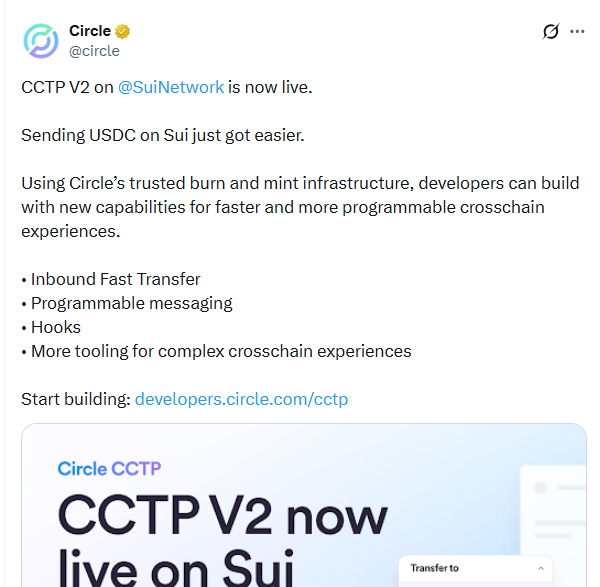
Source: Circle
A transfer begins when USDC is burned on the source blockchain. The burn provides the basis for the corresponding amount of USDC to be created on the destination network.
Circle’s system then provides the infrastructure needed to authorize the destination-side mint. The result is native USDC on the receiving blockchain rather than a wrapped representation created by a separate bridge.
For Sui users, that means USDC transferred through CCTP V2 arrives as native USDC. Sui said the integration allows the asset to move between its network and 29 other supported blockchains.
Why CCTP V2 Matters for Native USDC
CCTP V2 is not the first time native USDC has been available on Sui. Circle introduced native USDC on the network in October 2024. The latest development instead concerns the cross-chain infrastructure used to move that native asset between supported networks.
The distinction between native and bridged USDC is important because different transfer systems can create different representations of the same underlying asset. The model that CCTP uses does not require any USDC-wrapped tokens when moving native USDC via available routes.
The release of CCTP V2 has introduced new functionalities such as Fast Transfer and Hooks. The Fast Transfer is for quick cross-chain settlements, while Hooks enable automation of post-transfer actions on the destination chain.
Circle later designated V2 as the canonical version of CCTP. The company said CCTP V1 would become a legacy version, with its deprecation scheduled to begin on Oct. 31, 2026, and conclude on Dec. 1, 2026.
What Sui Developers Can Use It For
Sui said CCTP V2 allows developers to build payment and treasury products without designing their applications around a separate bridge. This places native USDC transfers within a standardized cross-chain framework supported by Circle.
The integration also supports transaction workflows on Sui. According to reporting on Sui’s announcement, USDC received through the CCTP V2 process can be used within the same inbound transaction, allowing activities such as deposits, swaps and payments to be combined into that transaction.
That functionality is relevant for applications that need to receive USDC from another blockchain and then perform an action on Sui. Instead of treating the arrival of USDC and the next application action as entirely separate processes, developers can incorporate them into a broader transaction flow.
Key Takeaways
- CCTP V2 went live on Sui on Oct. 8, 2026, according to Sui.
- Native USDC is burned on the source chain and minted on the destination chain.
- Sui reports connectivity with 29 other supported blockchains through the new integration.
What CCTP V2 Does Not Change
The Sui deployment does not mean native USDC itself is new to the network. That asset was already available on Sui following Circle’s 2024 launch.
It also does not remove every consideration associated with cross-chain transfers. CCTP remains dependent on Circle’s infrastructure and the participating blockchain networks. Users and developers must also ensure that they are using the intended native USDC asset and supported transfer route.
The 29-chain figure should likewise be understood as Sui’s reported figure for the launch. Current reporting confirms Sui’s announcement, but the exact live route list should not be expanded beyond what the available announcement supports.
CCTP V2’s arrival on Sui ultimately represents an upgrade to the network’s native USDC transfer infrastructure. With the current CCTP standard now live, developers can use Circle’s burn-and-mint system to move native USDC between Sui and supported networks without relying on a separate wrapped USDC representation for the transfer.