Tokenized stocks enable people to trade in conventional stocks out of normal hours in the U.S. market and even buy portions of single stocks. Nevertheless, according to an October 8, 2026, IMF report, such features carry some risk, and it is established that tokenized stocks are less liquid and 1.5 times more volatile than their conventional counterparts.
The report named Scaling Tokenization: New Efficiencies, New Vulnerabilities examined trading behavior on both centralized and decentralized platforms. Over half of the trades in the selected tokenized stocks were conducted outside normal trading hours in the U.S., and about 80% of them included less than one conventional stock.
What are tokenized stocks?
Tokenized stocks mean financial tools which use the blockchain technology. It makes it possible for one to access various financial products like Tesla, Nvidia, and Alphabet.
A unique feature of tokenized stocks is that they facilitate fractional ownership. This means that you can trade fractions of a share. The IMF found that approximately 80% of trades in its sample involved less than one conventional share.
These products can also trade outside regular U.S. stock market hours. Conventional exchanges generally operate from 9:30 a.m. to 4 p.m. Eastern Time on business days, while tokenized platforms may support evening, overnight and weekend transactions, depending on the venue.
The IMF studied five actively traded products covering Tesla, Nvidia, Alphabet, the S&P 500 and the Nasdaq 100. Its sample included products from Ondo Finance and xStocks across 11 trading venues.
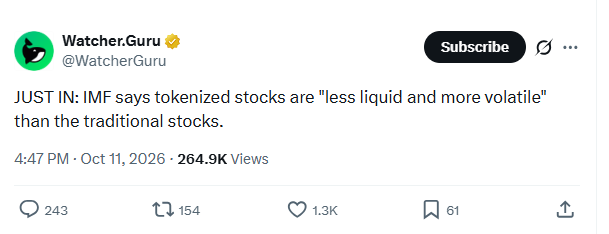
Source: Watcher. Guru
The analysis was conducted on approximately $345 million worth of tokenized equity, which constitutes about 15% of the overall value of tokenized stocks measured in the report. Data was obtained over 365 trading days and over 2 million five-minute data points of prices and volumes.
IMF Identifies Increased Volatility and Reduced Liquidity
From its findings, the IMF observed that the tokenized equities had about 1.5 times the realized volatility compared to their conventional counterparts. Realized volatility is an indication of the actual change in prices during a particular time frame.
The increased volatility, to some extent, was attributed by the IMF to lack of liquidity and trading when few players are involved in trading activities.
The greatest level of volatility was registered on decentralized exchanges, after which there were centralized cryptocurrency exchanges and traditional stock markets. Conventional equity markets also had better liquidity than decentralized exchanges.
Price disparities also differed between tokenized trading platforms. Trading platforms with high levels of volume usually had better correlation with the underlying stocks, but the prices in decentralized exchanges showed significant disparity from one another.
The IMF stated that their findings should be taken into account as being from a developing market.
Overnight Trading Can Inform Stock Prices
Despite these concerns, the IMF found that overnight price movements in tokenized equities carried information relevant to traditional markets.
The researchers have compared overnight tokenized stock returns with standard share prices over the initial five minutes when U.S. markets were opened. In line with the analysis made of the research, the amount of information about the overnight prices is from 87% to 99% contained in the standard prices.
This implies that tokenized stock markets have the potential to assist in price discovery despite the low volume of trading. However, according to the IMF, the size of the market and the small sample used constrain the ability to interpret the findings.
Tokenized Stock Market Still Small
The IMF approximated that the size of the market for public tokenized real-world assets was roughly $65 billion as of July 2026, excluding stablecoins and repurchase agreements. Tokenized equities made up around $2.3 billion.
| Market measure | Reported value |
| Tokenized real-world assets | About $65 billion |
| Tokenized equities | About $2.3 billion |
| Global equity market in 2025 | Just under $160 trillion |
| Relative volatility of tokenized equities | About 1.5 times higher |
The global equity comparison is based on figures from the Securities Industry and Financial Markets Association cited in the supplied material. Ondo Finance and Backed Finance together accounted for more than 70% of the estimated tokenized stock market value, according to the IMF.
Bullish introduced tokenized equity trading in August 2026. Earlier in October, OKX and Intercontinental Exchange filed plans for a platform offering round-the-clock trading in tokenized U.S. shares.
Legal and Settlement Risks Remain
The IMF identified fragmented platforms, legal uncertainty, liquidity safeguards and settlement arrangements as challenges facing tokenized financial products. Interoperability between systems also remains important because platforms and settlement tools do not always work together.
The report warned that automated margin calls and liquidations, collateral transfers between platforms and continuous trading could make future market shocks harder to contain.
Tokenization may automate dividend distribution, settlement, reporting and collateral transfers. Nevertheless, according to the IMF, such efficiencies will only be possible through compatible platforms, appropriate market participation, and effective settlement mechanisms.
According to the results, the tokenization of stock offers extended trading and fractional trading capabilities, but the liquidity and volatility issues are still prevalent. According to the IMF, the development of regulations is very important in such expanding markets.