

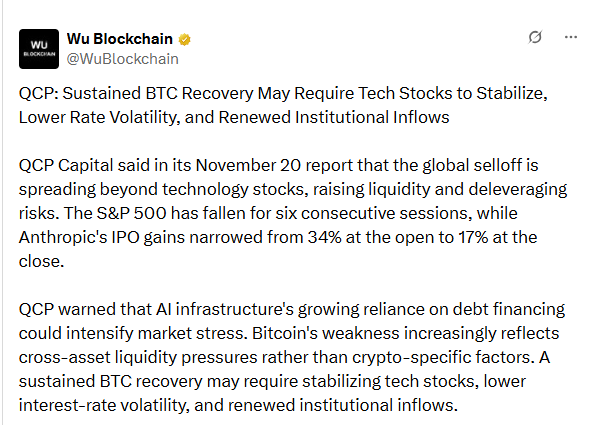
The overall picture in traditional financial markets is becoming even more bearish and difficult, QCP Capital states in its November 20 report, which questions the recovery of the Bitcoin price.
The recent weakness of the cryptocurrency does not imply only a problem in the digital currency market but a decreasing trend of liquidity and a decrease of risk aversion among investors.
QCP identified three conditions to help for a more sustained recovery, which are technology stocks stabilizing, reduced volatility in interest rates, and renewed inflows from institutions.
The assessment comes at a time when the losses have deepened in various U.S. stocks, and financing conditions are coming into question, while the financial markets are becoming more susceptible to spending on AI infrastructure. As investors pull out of a range of assets, Bitcoin is on the defensive as risk appetite shifts.
Bitcoin Bounces Back amid technology stocks’ declines.
Poor performance by technology stocks has emerged as a significant element in today’s market. The S&P 500 suffered its sixth daily drop, dropping some 2% to stay more than 8% from its monthly record. The Nasdaq 100 was also at its lowest level since April.
Source: Wu Blockchain
The percentage of the drop indicates that it’s not only a few high-priced tech stocks that are being sold. Over 90% of the S&P 500’s members were down, signaling a general pullback in portfolio risk.
Anthropic’s IPO was also a sign of investor sentiment shifts toward valuations of AI firms. It began with a 34% gain and made gains in the middle of the day before ending up a bit of a loser, but still a 17% increase.
The release of these developments has raised the needs of the AI sector to the fore. Investors begin to have reservations about promises accompanying monetary investments in infrastructure. The issues of the cost of AI infrastructure and debt financing are now more relevant.
These advances, according to the QCP assessment, relate to Bitcoin’s performance from a perspective of financial liquidity. Financial conditions tightening can cause pressure on crypto markets by a general sell-off of risky assets like tech stocks.
AI financing and interest rates help to trigger liquidity issues.
Another worry highlighted by the market is the growing dependence on debt to finance AI infrastructure. The ease with which investors are willing to invest in long-term spending projects, and, therefore, the ease with which borrowing costs can be lowered, may get more difficult.
Economic indicators in the U.S. are providing policymakers a very confusing picture, as initial jobless claims increased to some 203,000 and inflationary pressures are still an issue.
Investors are also being impacted by uncertainty from Federal Reserve policies.
The Bitcoin price can be pushed around by the interest rates. As the financial landscape evolves, so do people’s appetites for items such as crypto. QCP believes that this recovery will be more durable, and a key factor is that rates have not been jumping around too much.
The core inflation rate hit 2.2% in October, and the chances that the Bank of Japan would hike its interest rate were close to 86% in December.
The dollar also took a dive and the USD/JPY climbed to the 159s. However, the yen is now up for consideration as a funding currency in the international financial markets, since the attractiveness as a funding currency for the yen has been fading with the increase of the yen and the Japanese borrowing cost.
The November 20 QCP Capital assessment clearly shows the connection of bitcoin and conventional financial markets. The environment is very difficult, with tech stocks down, uncertainty about financing with AI and the Fed’s policy and reduced liquidity.
FAQs
What did QCP Capital say about Bitcoin’s recovery?
To sustain the recovery of bitcoin, technology stocks will need to settle back to normal, interest rates will need to return to normal, and institutional capital will need to return, QCP Capital said.
How exactly are tech stocks impacting Bitcoin?
The current tech stock sell-off is counter to markets’ risk-minimizing efforts. It could set off a liquidity crunch. Bitcoin and risky investments could suffer the same fate as that crunch.
Why is institutional demand important for Bitcoin?
In the past, money coming in from institutions has balanced out selling pressure. Consider ETFs and corporate treasury buys. It may be a sign of good news that new participation is coming back. This would drive demand up further.