

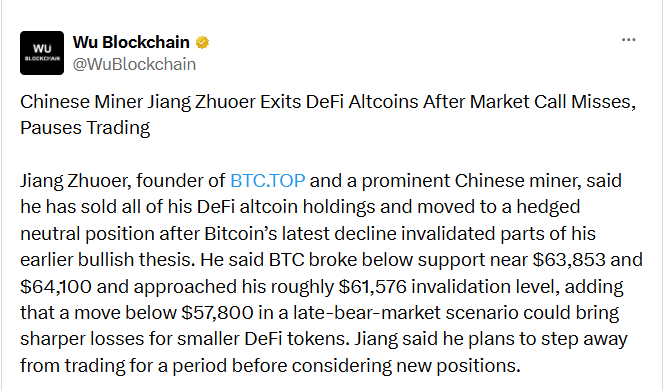
The sharp fall of Bitcoin to around $62,000 on November 15 made Daquan Jiang, founder of the group that created the small‑cap cryptocurrency TOP, say that he will sell all his holdings in the company’s small‑cap tokens and even pause trading for a while.
The Bitcoin miner said that this quick drop shocked him because he had been telling the story that the crypto market was in a bull run. He warned the DeFi tokens that if Bitcoin falls below $57,800 and the market moves into the later part of a bear cycle those DeFi tokens could lose even more.
On November 15 Jiang posted on X that he had finished closing his trades in the morning rebound and kept his loss limits in check. He said he was “hedged” with the rest of his cryptocurrency holdings and plans to “let this sit awhile and see how the market looks.
What does Bitcoin’s $57,800 level mean for DeFi altcoins?
The warning around $57,800 is not a breakout in the market but rather a conditional downside limit for Jiang. If the market is in a late-stage bear cycle he said smaller cryptocurrencies in the DeFi space could be hit more if Bitcoin drops below this price level.
Source: Wu Blockchain
This warning followed a failure in his technical levels. The POC, a measure showing chart volume was expected to provide support at the $63,853 price. It did just that. Bitcoin also went below $64,100, where he saw his defined 78.6% Fibonacci retracement level.
He had already set $61,576 as an invalidation level, based on a volume-area reading. Bitcoin fell within just $505 of an intraday low of $62,081 on November 15.
Bitcoin’s performance over the last seven days was still down by almost 14%, though it later bounced back up to just about $65,400. The recovery did not deter Jiang from his prior bull run call that the market was in the nascent stages of a bull run.
After selling some DeFi tokens, Jiang Zhuoer takes a hedged position.
Portfolio adjustment was not the only thing that was involved in Jiang’s portfolio adjustment. He called out what he considered a neutral arrangement that consists of 100% Ethereum long exposure, 100% Bitcoin long exposure and a 200% Bitcoin short position.
His short position was meant to reduce his overall exposure from his current position. This was, thus, not a total exit from the cryptocurrency markets, nor was it a complete shift from cryptocurrency to cash.
In a previous trading update, Jiang has provided a breakdown of the timing of the hedge in order to safeguard his BTC/ETH base holdings, while keeping his small-cap DeFi positions out of the hedge. He wanted to take a shot at selling the Bitcoin short when it re-enters the trading level from which it came.
The market’s decline changed Jiang’s view on the risks of small tokens. He confessed that he was severely mistaken with his medium-term market predictions and that he would take a break from trading for now.
Bitcoin continues to feel the pressure of liquidations and ETF outflows.
Jiang’s move coincided with the general slowdown in the crypto market. On November 15, nearly $1.96 billion worth of liquidations were reported, with close to $750 million pertaining to Bitcoin, according to Crypto.news.
In total, it seems that about $600.5 million of Bitcoin’s liquidations were made from a long side perspective. This forced closing was because leveraged traders were unable to pay up the collateral that had been attached to them.
There was further weakness in institutional investment flows, too. Institutional investor Farside Investors had $1.91 billion withdrawals from U.S. spot Bitcoin exchange-traded funds (ETFs) during the past seven sessions, ending on Nov. 13. Friday was the only day that saw outflows of $185.4 million.
US buying demand was further depressed one other measure. The premium discount for Coinbase continued for 51 days, up to November 13, in which Bitcoin was about 0.10% cheaper than its counterpart on Binance.
In the meantime, OneKey founder Yishi recommends investors to steer clear of leverage and speculative altcoins in the bear market, instead holding on to Bitcoin spot and having enough cash to cover living costs.
Conclusion
Smaller DeFi cryptocurrencies worry about downside risk as Bitcoin moves toward $62,000. After Bitcoin pushed through support levels that had been identified earlier Jiang Zhuoer decided to sell his small cap trades. After reevaluating market conditions Jiang Zhuoer chose to liquidate his cap deals.
FAQs
What was the reason for Jiang Zhuoer to sell his DeFi altcoins?
He liquidated his small cap DeFi holdings and lost money on Bitcoin’s sharp fall as he had expected the market to be in an early bull run. He said he cut back on the jobs as long as his losses were contained.
Why is the price $57,800 important for DeFi altcoins?
Jiang Zhuoer said smaller DeFi tokens may see larger drops if Bitcoin drops below this level and if the market is in the later phase of a bear cycle.
Has Jiang Zhuoer sold all of his crypto assets?
No. Jiang Zhuoer held Bitcoin and Ethereum on the side with a short, in Bitcoin to offset the long position. The arrangement was “neutral” and “hedged ” Jiang Zhuoer explained.