Key insights
- DOJ recovery efforts advance—Prosecutors are seeking permanent forfeiture of more than $1.1 billion in USDC.
- North Koreans get even tougher scrutiny—Investigators attribute the theft and laundering to TraderTraitor, which is believed to be operated by North Korean hackers.
- Even billions are hard to recover—Hackers keep swapping assets between different blockchain networks and using mixers and cross-chain solutions.
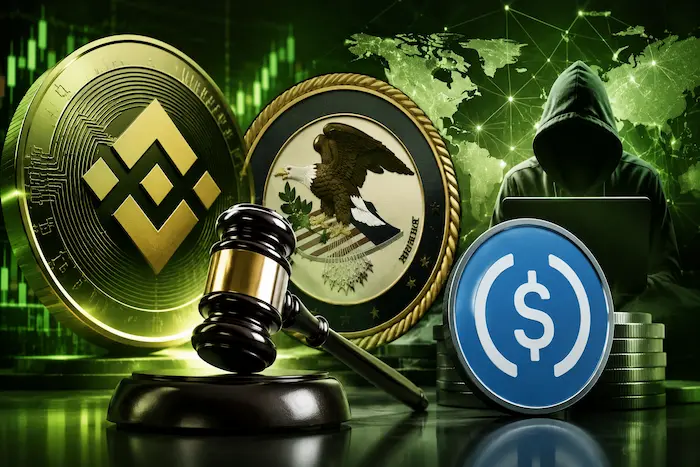
U.S. Department of Justice (DOJ) confiscated over $1.1 billion worth of stolen cryptocurrency from the Binance hack. On November 23, 2026, USDC was the subject of a civil forfeiture action by federal prosecutors in Washington D.C. related to the North Korean hackers. The action aims to recoup some of the $6.3 billion that was pulled from the world’s largest cryptocurrency exchange on Oct. 29.
🚨 NEW: The U.S. Department of Justice files a civil forfeiture action to recover more than $1.1 billion in USDC linked to the $6.3 billion Binance hack.
The funds are allegedly connected to North Korean hackers. The DOJ says U.S. authorities have helped freeze, seize or recover… pic.twitter.com/bVskxZr9Wk
— TheNewsCrypto (@The_NewsCrypto) November 24, 2026
The lawsuit marks another step in the international effort to recover assets connected to the attack. U.S. authorities attribute the theft to TraderTraitor, a hacking group linked to North Korea’s military. Meanwhile, investigators continue tracking billions of dollars moving across cryptocurrency networks.
DOJ targets funds linked to North Korean hackers
The Justice Department wants the court to permanently seize more than $1.1 billion in USDC issued by Circle Internet Financial. Prosecutors describe the stablecoins as proceeds from the Binance attack and subsequent money laundering activities
The DOJ says the targeted assets include 36 wallet addresses on 18 different blockchains. The money had already been subjected to a restraining order by the government after the incident. The circle has also, on its own, frozen the assets just after the theft.
The FBI, U.S. Secret Service and IRS Criminal Investigation jointly investigated the case. Their findings identified members of TraderTraitor as responsible for the attack. The FBI uses this designation for the North Korean hacking operation.
U.S. Attorney Jeanine Ferris Pirro noted that this is an example of how the government will stand up to the “high-tech” cybercriminals. She also called for strengthening efforts to recover stolen assets.
The DOJ said its broader recovery operation has helped freeze, seize or return nearly $3 billion since October 29. However, the forfeiture lawsuit must still pass through federal court before authorities can permanently acquire the targeted funds.
Social engineering exposed Binance’s security weakness
Investigators traced the breach to a social engineering operation targeting a Binance employee. The attackers reportedly impersonated recruiters and approached the employee with a supposed employment opportunity.
The employee agreed to an interview in the recruitment process, and installed malicious software. Malicious code was loaded into the employee’s device without their knowledge. This made it easy for the attackers to penetrate Binance’s internal network and hot wallet.
The Court documents explain how the EIP-7702 injection instructions were used in the intrusion. The technique has enabled attackers to penetrate systems and access cryptocurrency assets.
Binance subsequently closed the exploited entry point and rebuilt affected systems. Co-CEO Richard Teng also confirmed that the exchange accepted responsibility for customer losses.
The company replenished the affected assets using its corporate resources and emergency reserves. It also engaged Mandiant, SlowMist and Verichains to review its security procedures.
The incident brought to light the risks posed by an attack on employees. When the attack is not technical, but on human trust, even well-known cryptocurrency exchanges are not safe.
Billions of transactions are still being investigated on blockchains.
Blockchain analytics firm Elliptic has been able to trace the stolen assets in over 27,000 wallets and 16 blockchain networks. Its findings show that hackers continue moving portions of the funds through several laundering methods.
The investigation identified at least $247 million in Bitcoin transactions involving mixing services. These services combine transactions to complicate efforts to identify the original source of funds.
On November 17, attackers also emptied five major Ethereum wallets associated with the theft. They moved around $860 million worth of Ether on Thorchain before they slowly shifted some of them to Bitcoin.
Additionally, the hackers used cross-chain bridges, lending platforms and worthless meme coins. The transactions made it more difficult to track and move the stolen assets.
So far, the recovery is still substantial with different recoveries in different investigations. Elliptic estimated that it was an estimated $2.85 billion which was frozen or seized. Meanwhile, some $2.22 billion was still in wallets linked to the attackers.
Tether has also frozen a substantial amount of USDT linked to the incident. Earlier reports placed the frozen balance above $1.5 billion. Recovering those funds could require additional international coordination.
The Binance recovery process and implications are covered
The new lawsuit does not affect Binance customer deposits. Prosecutors, however, are trying to recover the stolen USDC through a civil forfeiture action.
After the public notice of the lawsuit, all eligible claimants have the opportunity to file formal claims within the time limits of the courts involved. Binance may seek the assets as they had been the first to lose money and have paid back those affected.
The judge can rule for a final forfeiture, meaning that the frozen tokens could end up with the U.S. government. Binance can then request for remission to recover the assets. The support of Circle would continue to be crucial in the process.
The judgment could be a precedent in the future for law enforcement’s response to a cryptocurrency theft of a centralized exchange or stablecoin issuer. The capability of Circle to freeze $USDC is a good example of the positive way centralized controls over a token can help with law enforcement investigations.
But there are different recovery challenges with Bitcoin and Ether. Unlike stablecoins, their decentralized networks do not offer the same direct freezing mechanisms to issuers.