

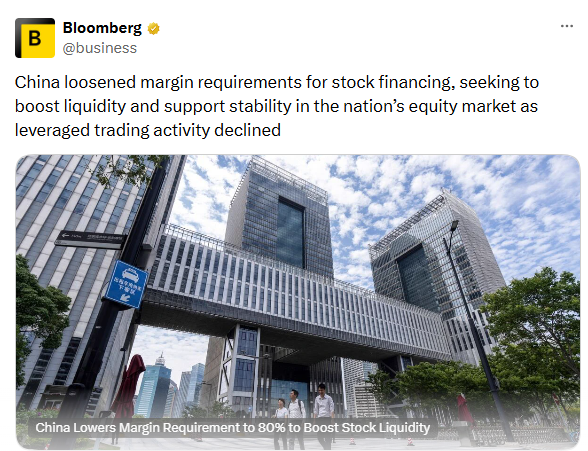
All three major exchanges are making adjustments to the margin financing rules as authorities in China move to help turn around the struggling equity markets. The minimum margin ratio for investors will be reduced from 100 percent down to 80 percent in the Shanghai, Shenzhen, and Beijing exchanges, increasing their leverage and ability to raise more funds via their existing positions, from Nov. 30th, 2026.
This is in response to dropping share prices, decreased margin financing, and overall market uncertainty. The exchanges are also suggesting cutting trading fees and Shenzhen has suggested a model to establish market makers on its ChiNext board. The measures are implemented to improve the liquidity, reduce costs of trading, and improve the stability of a market.
What will be the impact of 80% margin rule for stock financing in China?
The key of the new policy is the decrease of the minimum margin ratio. The investor does not now have to pay 100% of the money. That rate is revised to 80% to be effective Nov. 30.
Source: Bloomberg
This change will enable the eligible investor to obtain additional financing while not varying the amount of securities that are being used as collateral. That’s because the relocation of the exchange will lessen the need for margin, which will free up money for market participants to buy stocks on credit.
The three exchanges said that the level of margin financing activity had fallen much and the market leverage levels were low. They said the new rules would provide more liquidity to the market, which would be beneficial to China’s stock markets’ long-term stability and healthy development.
The change also overturns a policy put in place in January, which raised the minimum margin ratio to 100%. The new ruling is a step to loosening financing terms that have been less active for several months.
The activity of traders has weakened, with falling margin loans highlighting this situation.
The lower margin requirement comes as one of China’s biggest stock markets’ borrowings is slowing down.
The volume of margin loans has dropped by over 20 percent, from around 3 trillion yuan at the end of June. The balance is now at about 2.2 trillion yuan, or about $329.5 billion.
This is a reaction to the decrease in the financing activity prior to the previous policy announcement. One of the factors that can help investors get into a stock trade is an increase in margin financing; this can allow the investor to buy more stock.
In response to the financing conditions in the announcement, the exchanges are reducing the margin ratio. Reduced needs would make more money available to qualified investors for borrowing, but the policy doesn’t specify how much supplemental borrowing will be achieved.
The measure also comes at a challenging time for several key Chinese equity indexes. The Shanghai Composite Index fell almost 3% for the week that started on Nov. 9, its lowest point in 16 months.
The technology-heavy STAR Market and ChiNext in Shenzhen, on the other hand, have both declined by over 40 percent from their peaks in June. These are all contributing to worries about market performance.
Lower trading fees and disclose plans for ChiNext market making.
The margin financing adjustment won’t be the only adjustment that will support Chinese stocks. The trading fees are announced separately by the Shanghai exchange and the Shenzhen exchange, both of which will reduce them.
The proposed cuts are to lower the expense for investors for transactions and boost investor confidence and market participation. The announcement does not include a figure for the cost of the cuts, but it is part of the exchanges’ huge support package.
Shenzhen has also released draft regulations which require that there be a system for the ChiNext board to act as a market maker. The suggested solution aims to deal with price volatility in shares and to enhance the effectiveness of shares pricing.
According to the exchange, the mechanism will facilitate the decrease of price volatility and efficiency in prices and make the market more resilient.
All of these are targeted towards different aspects of equity trading. The two where the lower margin requirements have a direct impact are access to finance and fees; the proposed ChiNext mechanism is trading conditions and price formation.
More comprehensive measures to stabilize China’s stock market.
The exchange-level decisions came in the wake of moves that Beijing made in early November to spur share buying.
Moreover, other Asian markets have responded to the stock market uncertainty by taking steps to try to defuse the situation by making regulatory changes to ease trading activity in the markets.
The new policies are just a component of China’s broader regional response to the uncertainty in the market. But the exchanges haven’t demonstrated that the changes will turn the tide on the recent decline in share prices.
Conclusion
The 80% margin rule is a big change in equity financing, as China’s investors will be able to borrow more with the same collateral starting from November 30. The changes, along with trading fee cut and the proposed “liquidity provisioning mechanism” in Shenzhen (ChiNext), are designed to enhance trading liquidity and boost trading. What impact these will have on the actual market conditions will depend on how market participants react to the new conditions.