

Tokenized stocks offered on OKX have brought into focus the issue of the corporate reaction to third-party representation of publicly traded shares by means of tokenization.
OKX, an online cryptocurrency trading platform, and Intercontinental Exchange (ICE), which owns the New York Stock Exchange, have joined forces through OKXICE to enable tokenization trading of 62 companies.
However, the opposition from large firms like Nvidia, Micron, Nike, Costco, and Reddit is posing the question of whether the companies will get into third-party tokenized stock offers and how the availability of the securities is regulated within the framework of the SEC.
These objections fall under the temporary conditional exemption rule by the Securities and Exchange Commission (SEC), which provides qualified platforms with the opportunity to conduct experiments involving blockchain trading within five years. According to the conditions, public issuers can block tokenized offerings by unaffiliated third parties on the venue through written objection within 30 days of notice.
What Are the Issuer Objections in Tokenized Shares Trading?
The issuer objections arise where the companies object to trading of the tokenized version of their shares on the trading platform. Within the OKXICE, the SEC framework allows public companies to officially object to third parties offering such tokenized representation of their shares.
This ensures that the shares of the company differ from the tokenized shares issued by the third party. It also means that appearing on a proposed trading list does not automatically guarantee that a company’s shares will become available through the venue.
Companies must submit their objections in writing within the designated 30-calendar-day period after receiving notice.
How the SEC Framework Applies to OKXICE?
OKXICE is developing its trading venue under a temporary SEC framework that allows qualified providers to test blockchain-based securities trading through a five-year innovation exemption.
However, the exemption doesn’t necessarily mean that any and all the proposed firms would have their shares tokenized in this manner. Publicly traded companies also have the right to object to this.
OKXICE, in particular, faces this objection regarding its selection of equities. It needs to take into consideration any eligible objections before tokenizing the shares.
How Issuer Objections Affect Tokenized Shares on OKX?
The immediate effect that issuer objections may have is that such issuers can be excluded from the offering being proposed on the OKXICE platform.
According to the mentioned framework, unaffiliated third-party tokens issued by objecting companies cannot be traded through the platform. As a result, there will be a change in the venture’s initial list of 62 companies. The more companies object, the fewer shares there will be in the arrangement.
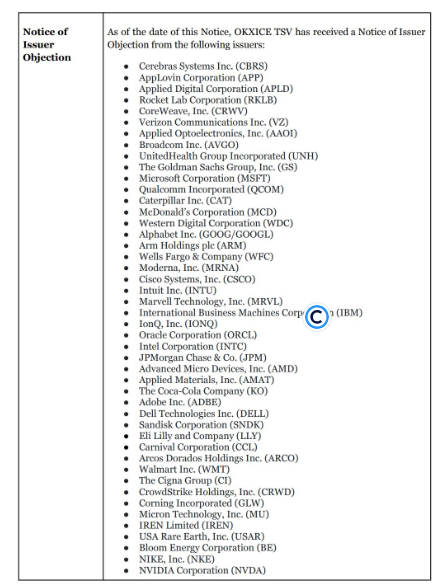
Source: Wu Blockchain
This indicates that if the company appears on the initial list, it is not guaranteed that one can access its tokenized representation via OKXICE; its availability will depend partly on whether the issuer files an objection under the required conditions.
The objection mechanism serves to distinguish the shares of conventional companies from the tokenized representations offered by unrelated third parties.
Which Companies Have Filed Objections to OKXICE?
Some of the newest companies who have filed objections include Nvidia, Micron, Nike, Costco, and Reddit.
The supplied report describes the total number of objecting companies as having reached 50. Another passage states that 33 of the original 62 proposed companies had objected. These figures refer to different reported counts and should not be treated as interchangeable.
Wells Fargo is also said to have lodged an objection despite being absent from OKXICE’s first list. These facts were mentioned in the public notice reported initially by Coinbase.
What This Means for Tokenized Stock Trading?
The OKXICE case clearly illustrates the role of issuer objections and regulatory conditions in the supply of tokenized equities.
Though the SEC framework allows the qualified vendors to experiment with blockchain-based trading temporarily, companies still have a right to object to third-party tokenization of their shares.
For the venue, objections affect the selection of companies included in its proposed offering. For investors, they determine which tokenized representations may be available through the platform.
Ultimately, issuer objections establish an important limitation within OKXICE’s proposed trading arrangement: regulatory permission to test tokenized stock trading does not guarantee that every company’s shares can be included.
Frequently Asked Questions
What are issuer objections on OKXICE?
The formal written complaints are submitted by firms to avoid any third party not related with the firms from tokenizing their shares on the platform.”
How long do companies have to object?
Issuers have 30 calendar days after receiving notice to submit a written objection.
How many companies have objected?
The report states there are 50 protesting firms, while another part of the report says there are 33 protestations out of 62 suggested firms.