
Crypto theft leads to huge financial losses. Nevertheless, tracing and recovery of the stolen money is not merely a process of discovering the wallets into which the funds were sent. The process includes tracing transactions, freezing money by exchanges and token issuers, and finding ways to compensate customers for their losses.
The October 29, 2026, Binance hack is one of those examples where there were around $6.3 billion of affected funds, $3 billion was frozen on the chain, and Binance stated on October 30 that it had a reserve worth over $6.34 billion to cover customer losses.
Source: CoinMarketcap
Details of the Binance Hack
At first, the findings of the investigation made by Binance revealed the possibility that the attack on the exchange had involved compromising a laptop of a DevOps engineer, gaining access to a service container, and submitting unauthorized withdrawal transactions.
The exchange later reported additional points of breach but did not provide a complete technical explanation. Binance said it had found no evidence that wallet private keys were leaked and promised a detailed technical report after verifying its findings.
Blockchain intelligence firm TRM Labs traced approximately $6.36 billion in transfers from Binance wallets across ten blockchains. Most transfers occurred within approximately 20 minutes, according to its analysis.
TRM attributed the incident to TraderTraitor, a North Korean hacking group, based on its assessment of on-chain and off-chain intelligence. Such an attribution continues to be the company’s opinion and not a conclusive determination made by the investigation of Binance.
The Role of Blockchain Tracking in Recovering Stolen Money
Blockchain public records give the investigator an opportunity to trace the flow of cryptocurrency transactions from one wallet address to another and analyze the timing and amount of each transaction. They are also able to track any further actions associated with such transactions.
However, just because a transaction is traceable, it doesn’t mean that an individual who controls a wallet can be identified. There is a need to differentiate between assets which are traceable, those that can be frozen, and the cryptocurrency that has escaped the reach of the participating entities.
TRM Labs reported that the attacker moved assets across multiple networks and used decentralized trading and lending services. Such activity complicates recovery because different assets and platforms have different technical controls.
Why Certain Cryptocurrency Can Be Frozen?
The Binance hack shows the reason behind the freezability of some assets being linked to the type of cryptocurrency at hand. The issuers of centralized stable coins have certain methods by which they can prevent transactions from certain addresses, enabling them to freeze some assets due to thefts.
Binance claimed to freeze roughly $3 billion in collaboration with industry partners. According to TRM Labs, Tether, Circle, Ripple, and World Liberty Financial managed to freeze roughly $2.67 billion worth of stablecoins, with an additional amount of ETH and ARB being frozen by the Arbitrum Security Council. These figures reflect different reporting methods and should not automatically be treated as identical totals.
Not every cryptocurrency can be frozen by a central issuer. When assets move into wallets outside the control of cooperating platforms, investigators may track them without having a direct mechanism to stop transfers. A freeze also does not necessarily establish ownership or mean that funds have been returned to customers.
Binance Reserves $6.34 Billion for Customer Losses
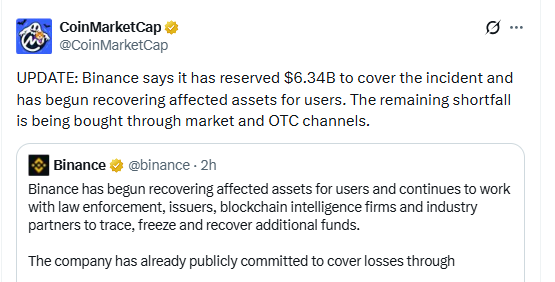
Binance’s October 30 announcement addressed customer compensation separately from asset recovery. The exchange said it had reserved more than $6.34 billion in company funds to cover losses and had begun restoring affected assets.
According to Binance, approximately $5 billion of the reserve was already held in the affected tokens. The company was acquiring the remaining roughly $1.34 billion through market purchases and over-the-counter transactions so affected users could be reimbursed in the same assets.
Binance said limited liquidity in some tokens and OTC settlement times could slow the process. The reserve does not include the approximately $3 billion frozen with industry partners.
What the Incident Means for Crypto Exchange Security?
Binance temporarily suspended deposits and withdrawals during initial security checks, revoked authorization for affected addresses, and engaged law enforcement and blockchain intelligence partners.
However, in an update that followed, deposits were working fine but withdrawals were still not functional due to ongoing security enhancements. Proof of Reserves would also be published by the exchange at a later date.
The case of Binance demonstrates that while freezing of assets is different from covering losses incurred by clients. Industry collaboration can stop certain transfers while company reserves can compensate for the loss suffered by customers without having to retrieve all the stolen tokens.