

KEY INSIGHTS
- Binance blocks North Korean-related cyberattacks; no breach of security or loss of assets was noted.
- The Contagious Interview scheme uses fake job offers and coding tests to make victims execute malicious programs.
- Binance warned users to verify their job offers and not to execute unknown programs.
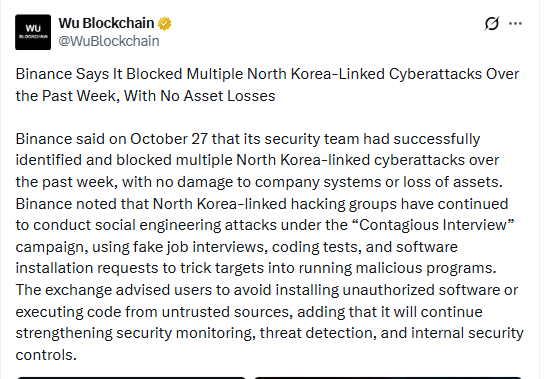
Crypto Exchange Binance announced on October 27, 2026, that the firm had defended itself from numerous cyber-attacks associated with the North Korean hackers in the last week without compromising any of its systems or putting its customer funds at risk.
The exchange stated that the attacks were made through a social engineering scheme known as “Contagious Interview,” which involved the use of a fake recruiting process to make targets execute malware programs.
The report reveals the security risk, which involves deception tactics rather than any system breach attempt. As per Binance, the attackers contacted the targets through seemingly genuine employment offers to trick the targets into launching harmful code after passing various interviews and coding tests.
This approach can be difficult to recognize because downloading and testing software is a familiar part of many technical recruitment processes. The candidate who feels that the possibility is real can complete a project that uses unknown code without being aware that the code may harm his system.
Binance stated that its security features helped prevent the attack from succeeding or causing any losses.Because of the campaign, users and employees were asked to be cautious when using unknown code or software.
How the Contagious Interview Attack Campaign Works
The Contagious Interview attack campaign employs a staged recruitment program for building trust between the victims and the campaign. People are offered a job and made to follow the recruitment process before being given coding exercises.
Source: Wu Blockchain
Instead of using physical attacks to obtain access, this technique works due to the willingness of the target to carry out a specific action. In this case, the code evaluation will be a good rationale for downloading files, opening projects, or executing command lines on a personal computer.
Such a situation can be seen as a problem for software developers and other specialists dealing with computers, since they may frequently come across unknown code either in their work or in the process of getting a new job.
According to Binance, users needed to ensure the legitimacy of the recruiting process and exercise caution before carrying out any actions through software. Moreover, among the recommendations provided by Binance, the requirement to refrain from using unauthorized and unverified software codes was highlighted.
The company highlighted the significance of employee awareness and internal monitoring within its security strategy. No such incident was reported in which the recent attacks were successful.
Threats Linked to North Korea and the BNB Chain Attack
The warning comes against a backdrop of rising threats of cyber operations by the North Korean threat actors directed at the crypto industry. The groups believed to be operating within North Korea include Lazarus Group and SquidSquad, among others.
Recent attacks have seen a total of $2.84 million stolen from the BNB Chain on October 8, 2026, through SquidSquad. The incident provides context for the security concerns surrounding cryptocurrency infrastructure, but it was separate from the attacks Binance said it blocked during the following week.
The distinction matters because the reported outcomes were different. The BNB Chain incident involved funds being drained, while Binance said its security measures prevented the more recent attempts from compromising its systems or causing asset losses.
The exchange’s October 27 disclosure did not establish that the blocked attacks were directly connected to the October 8 incident. However, both represent cases of reported security incidents that have posed a threat to the crypto space.
What Binance’s Warning Means for Users
In Binance’s alert, users are advised to be careful with recruitment requests, downloads, and running software. Users are especially advised to be wary of any unsolicited job application which forces them to install unknown software before confirming their identity.
However, users seeking technical employment in the crypto industry find it hard to distinguish between a legitimate and malicious hiring process because both may entail remote interviews or code tests. The fraud described by Binance relies on such resemblance to make the dubious actions appear natural.
Binance mentioned that its monitoring and protection mechanisms allowed it to neutralize the attack and render it harmless. At the same time, the caution of Binance points out that one should always be alert, particularly when working with untrusted software or code.
The firm encouraged its employees and users to be wary of suspicious recruitment practices and not to execute unverified codes due to ongoing cyber threats from North Korea posing a risk to the cryptocurrency industry.
Frequently Asked Questions (FAQs)
What cyber-attacks were reported by Binance on October 27, 2026?
According to Binance, several cyber-attacks associated with North Korean threat actors were blocked within the last week without compromising any of their systems or their assets.
What is a contagious interview scam?
Contagious Interview is an example of social engineering attack which uses fake job offers, interviews, and coding tests to execute malware.
ding to Binance, several cyber-attacks associated with North Korean threat actors were blocked within the last week without compromising any of their systems or their assets.