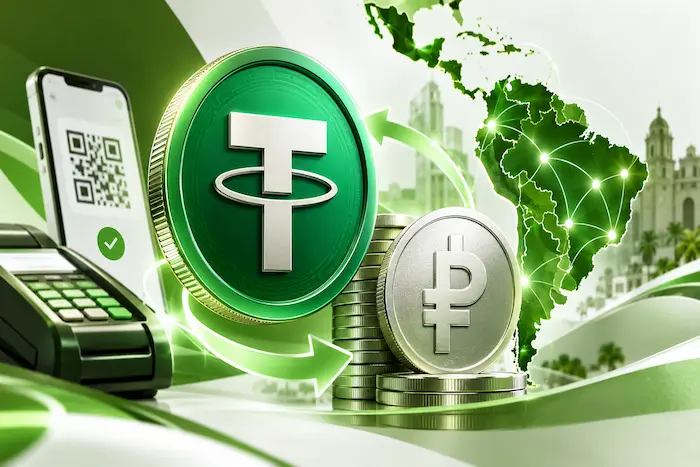
Tether has invested in Bolivian fintech company Peso as it looks to make USDT payments easier across Latin America. The pre-seed funding will help Peso expand its services, connect with more local banks and businesses, and allow people to use digital dollars for everyday payments.
In an October 21 announcement the stablecoin firm said that Peso connects stablecoins with local banks and payment services. This allows users to send money across borders, exchange currencies and pay for goods without relying entirely on traditional banking services.
Tether Targets Everyday Payments Through Peso
Peso gives users access to USD₮ accounts for saving, spending, investing and sending money internationally. The platform connects digital dollars with local financial services, allowing people to use stablecoins outside cryptocurrency exchanges.
The company has already integrated USD₮ payments into Yango, a digital services platform operating in Bolivia. Customers can order food through the app and pay using USDT. Peso also offers payments at physical stores and virtual bank accounts registered in users’ names.
In Bolivia, Peso connects USDT with local banking services through QR code payments and automated clearing house (ACH) transfers. These services allow users to move money between stablecoins and local currencies using familiar payment methods.
The new funding will help Peso expand into Bolivia, Brazil, Colombia and Argentina. The company also plans to develop its payment services for businesses and improve access to virtual accounts.
Tether CEO Paolo Ardoino said the investment would help people use USDT for daily purchases rather than keeping it mainly as savings.
“Peso is building the kind of everyday-spend infrastructure that turns USD₮ from a savings tool into a payments channel people rely on daily,” Ardoino said.
He added that the investment supports Tether’s goal of making financial services faster, easier to access and more connected.
Peso CEO and co-founder Alejandro Terán said many people in Latin America already use USDT, but spending it on everyday purchases has not always been easy.
“Latin Americans are already using USD₮; what was missing was the infrastructure to spend it in everyday life without friction,” Terán said.
Terán said Peso aims to make account opening simple and allow customers to use USDT for QR code payments and international transfers.
Tether Expands Investments in Payments and AI
Peso is not the only payment company to receive Tether’s backing. On October 13, Tether announced an investment in EFY Finance during the company’s seed funding round.
EFY Finance provides services that help individuals and businesses use USDT and USA₮. These include accounts, digital wallets, payment cards, asset storage and large transactions handled directly between parties.
The company says it serves more than 25,000 active personal and business accounts. It also supports transfers to local bank accounts in 17 countries, including Bolivia, Colombia, Mexico, El Salvador, Panama and Ecuador.
EFY Finance holds a Digital Asset Service Provider license in El Salvador. However, Tether did not reveal how much it invested or the total amount raised in the funding round.
EFY Finance plans to expand its stablecoin payment services for businesses and financial institutions.
Tether has also invested in payment technology designed for businesses and artificial intelligence systems. The company led a $15 million Series A funding round for New York-based fintech firm Mural, bringing Mural’s total funding to $28 million. North Island Ventures and existing investors also participated.
Mural develops tools that allow businesses and AI agents to manage payments across traditional banking networks and blockchain systems. Its services cover accounts, transfers, identity checks and regulatory requirements.
The company’s customers include payroll platform Deel and browser developer Opera.
Mural also helps businesses control payments made by AI systems. Companies can set spending limits, restrict who receives money and require approval before larger transactions go through.
Stablecoin Market Slips as Tether Faces Scrutiny
Tether’s investments come as the stablecoin market remains above $300 billion in total value. According to DeFiLlama data, the market reached $301.1 billion on October 21, 2026.
However, the market fell 0.84% over the previous seven days. It also recorded a 0.11% decline over the previous 24 hours and 30 days.
Source: DeFiLIama
Stablecoin market value reached nearly $190 billion in 2022 before falling to about $120 billion in 2023. The market recovered in 2024 and continued growing through 2025, eventually passing $300 billion.
USDT accounted for 60.68% of the total stablecoin market, according to the data.
Meanwhile, Tether is facing questions about its handling of cryptocurrency transactions connected to sanctioned entities.
On October 19, Ardoino said the volume of USDT transactions linked to Iran had fallen 94% after Tether froze wallets connected to Iranian financial networks.
He also claimed Tether froze certain wallet addresses an average of four weeks before U.S. and Israeli authorities formally designated them. According to Ardoino, Tether acted before Chainalysis identified the addresses in 99% of cases.
Source: X
However, Tether has not independently released the methods or transaction data used to support the reported 94% decline.
A U.S. Senate report has also questioned how the company handles wallets connected to sanctioned entities and called for investigations into its compliance practices.
Separately, a Wall Street Journal report published on October 14 examined payments Tether made to Nxum, a consulting firm co-founded by former White House crypto adviser Bo Hines.
The report said Nxum received $6.3 million under a contract to develop a plan for Tether’s branding and public relations activities.
Hines later joined Tether’s U.S. division after leaving government service. The arrangement has raised questions about the connections between the stablecoin industry and people involved in shaping cryptocurrency policy.