

Russia has started employing its central bank digital currency for paying salaries, as employees of the Ministry of Finance received their October 1, 2026, salary in digital rubles for the first time. The payments were voluntary and required employees who participated in them to create digital ruble accounts on the platform of the Bank of Russia.
However, no information is available about the number of employees participating in this trial and the total amount that was paid out. The development therefore does not represent a full conversion of government salaries to the CBDC. Instead, it is an initial real-world use of digital rubles for government payroll.
What the Bank of Russia Says About the Digital Ruble
The Bank of Russia’s August 31, 2026 announcement, “Digital ruble launched,” provides the framework for the broader rollout that began on September 1. The central bank said major banks and retail companies would make their infrastructure available for digital-ruble transactions from that date.
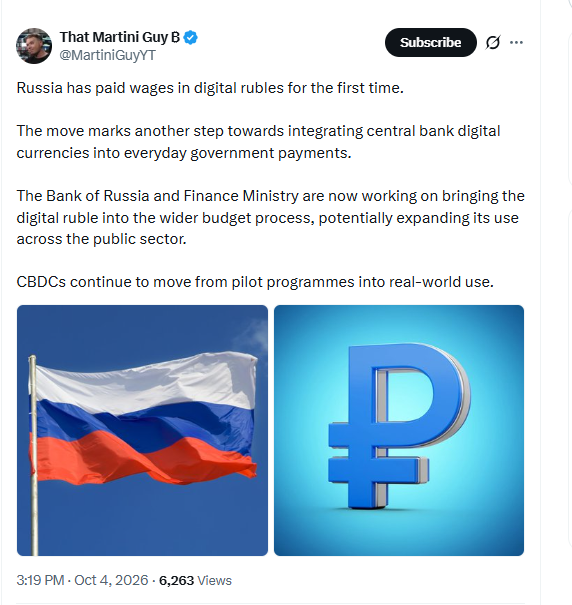
Source: The Martini Guy
Individuals who choose to use the currency can open an account on the Bank of Russia’s platform through the mobile application of a connected bank.
The Bank of Russia describes the digital ruble as a new form of Russia’s national currency alongside cash and conventional non-cash rubles. Its September 1 FAQ also states that citizens retain the choice of which form of the ruble they use. Digital-ruble wallets are opened only at a person’s request and are not created automatically.
The same FAQ makes clear that the digital ruble is not a cryptocurrency. It is issued by the Bank of Russia as a form of national currency, while cryptocurrency does not have a single central issuer responsible for it at the state level.
How Russia’s Digital Ruble Salaries Are Paid
The October 2 Ministry of Finance announcement, as reported independently by Interfax, established the specific payroll milestone. Some Finance Ministry employees received their October 1 salaries in digital rubles after opening accounts on the Bank of Russia platform.
Participation was voluntary. Employees had to choose the digital-ruble payment option rather than being automatically transferred from conventional salary payments.
The arrangement had already been incorporated into the central bank’s payment framework before the October payroll. By its June 19, 2026 tariff decision, the Bank of Russia determined the amount of a special tariff applicable to legal entities transferring digital rubles to natural persons for salaries and payments arising under labor agreements.
This decision determined the tariff for the platform to be zero for the period up until the end of 2026 and to consist of a fee of 1 ruble per executed instruction as of January 1, 2027, not lower than 15 rubles per register.
The subsequent August 28 Bank of Russia tariff decision determined the general tariff schedule starting from September 1, 2026.
| Date | Development | Source |
| Aug. 31, 2026 | The Bank of Russia launched the expanded use of digital rubles. | Bank of Russia |
| Sept. 1, 2026 | Banks and qualified retailers started wider use | Bank of Russia |
| Oct. 1, 2026 | Some Finance Ministry employees received digital-ruble salaries. | Finance Ministry / Interfax |
| Jan. 1, 2027 | Scheduled ₽1 tariff per executed salary instruction | Bank of Russia |
Why the Payroll Test Matters?
The salary payments are part of a wider effort to incorporate the digital ruble into Russia’s government financial infrastructure. Earlier official information indicates that that Russia had already tested digital-ruble transactions in the federal budget process during 2025, including salaries, student stipends, and some government-contract payments.
The Bank of Russia’s also explains that digital rubles can be used for payments involving the government. Its rollout framework includes transfers to and from government entities alongside other types of digital-ruble transactions.
This makes the October payroll different from a limited technical demonstration. A government employee receiving a salary in digital rubles represents a direct use of the system for an ordinary public payment.
Key Takeaways
- Russia’s Finance Ministry confirmed that some employees received digital-ruble salaries on October 1.
- The payments were voluntary and required employees to open digital-ruble accounts.
- Bank of Russia rules had already established the infrastructure and tariff framework for digital-ruble payroll payments.
Adoption Has Not Been Established at Scale
The available information does not show how widely digital-ruble salaries are being used across Russia’s public sector. The Ministry of Finance has not provided information regarding the number of people and the amount of the payroll that has received salary payment on October 1 using digital rubles.
The Bank of Russia claims that there is no interest accrued on digital ruble balances because this currency is meant for payments and transfers rather than for saving and loans.
The deployment process is also gradual in nature. The Bank of Russia reveals that major banks and some retailers joined the network on September 1, 2026, while other financial institutions are expected to join the program in 2027 and 2028.