
Binance CEO Changpeng Zhao, popularly called CZ, has admitted that leadership of the exchange were negligent in their duty to keep their systems secure prior to the hack on October 11, 2026, which resulted in the loss of around $6.3 billion worth of digital assets. Zhao.
In his remarks during Binance Blockchain Week, Bangkok, on November 28, noted that over the past few years, the top executives have focused on other matters as they had not experienced a significant security event in years. His remarks pointed out some flaws in the internal security monitoring and what Binance did to recover lost assets.
Binance’s Security Breach Revealed Leadership Vulnerabilities.
“Over the past few years, it seems that Binance’s focus on security has shifted to a lesser degree,” Zhao said. No matter how long the company has gone without a big attack, security should always be the top priority, he said, adding that the company has demonstrated its commitment to the issue.
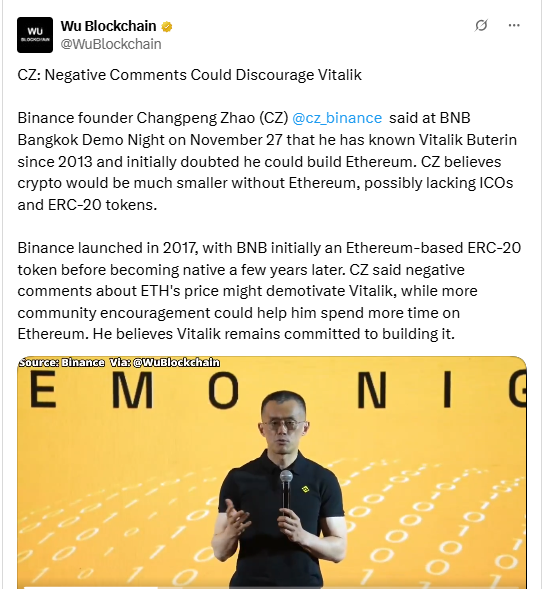
Source: Wu Blockchain
The attackers went through the recruitment process to get to employees. The attackers exploited vulnerabilities in the company’s systems through malware, stole the source code and then used artificial intelligence to analyze it in just one day, according to Zhao. Previously, a person would have taken about six months to do the same job,” he estimated.
Binance’s security chief separately said that the incident was an on-chain approval that wasn’t authorized. The exchange had stopped withdrawals but still reportedly continued to transfer for a period of time.
Zhao urged cryptocurrency firms to report on security incidents, such as those revealing internal errors. He also cautioned businesses to brace for scenarios in which attackers were able to get access to the source code and leverage AI tools to exploit vulnerabilities.
Binance Recovery Services and Binance Withdrawal Services.
Binance had a phased withdrawal suspension after the breach to work through the incident. On November 1st, the reopening process started, and services started to be restored progressively on supported blockchain networks.
In the first 9.5 hours of reopening, Binance saw around $4.65 billion withdrawn and $1.01 billion deposited. Withdrawals then slowed as the initial demand subsided, the exchange reported.
As of November 26, almost all networks were back to normal withdrawal operations. A few were temporarily unavailable due to maintenance or scheduled for improvement.
Binance shared that it has leveraged about half of its Secure Asset Fund for Users (SAFU) and half of its futures insurance fund for this recovery. The company’s corporate treasury also played a part in the replacement of the affected assets.
Binance had allocated over $6.34 billion in company funds for the recovery. It initially possessed around $5 billion worth of the afflicted cryptocurrencies and acquired the remainder by means of market trades and OTC.
As of November 13, the exchange reported replacing all the affected token assets, it said. It also took a snapshot of the 198 tokens for a proof-of-reserves check on November 12. The accompanying cryptographic verification allowed customers to verify that their assets were supported at least one-to-one, Binance said.
U.S. authorities are hunting for cryptocurrency stolen from the system.
The recovery process wasn’t limited to Binance; it also included cryptocurrency issuers and law enforcement agencies.
The U.S. Department of Justice announced on November 23 that it was commencing a civil forfeiture proceeding against over $1.1 billion that the U.SDC allegedly lost to Binance and that North Korean individuals are responsible for these thefts. The department stated the cryptocurrency had previously been under a court order of restraint.
FBI, U.S. Secret Service, IRS Criminal Investigation, and the assistance of Circle in the investigation.
Since the October breach, U.S. authorities have also been able to help freeze, seize, or recover over $2.9 billion in cryptocurrency from various sources, the Justice Department added.
On its own, Binance received an injunction on November 18 from the Abu Dhabi Global Market Courts to aid its recovery actions in connection with the incident.
CZ suggests enhanced security partnership in the crypto market.
Zhao urged the creation of a security alliance among cryptocurrency companies for sharing information and coordinating responding to and reviewing security practices.
During a significant security breach, he noted, Circle and Tether, the two major issuers of the stablecoins, and U.S. investigators were examples of other parties that cooperated.
During the next few months, companies may have to spend up to 80% of their time on security, said Zhao. He also said that companies should make the assumption that hackers might be able to get their source code and analyze for vulnerabilities using AI.
His offer is designed to promote transparency and collaboration in the crypto sector.
Conclusion
Zhao’s entry has sparked a debate about why leadership oversight, employee security, and incident response coordination are essential in the cryptocurrency space. Binance says it has replaced the impacted assets and restored all withdrawal services. Still, investigations and recovery work remain parts of the aftermath.
His proposed security alliance is an attempt to get more digital-asset companies to cooperate in the face of ever more sophisticated cyber threats.
Frequently Asked Questions
What did CEO CZ say about the Binance security incident?
Binance’s top executives have not paid enough attention to security previously, said Changpeng Zhao.
Who is at fault for the Binance hack?
Binance’s disclosure indicates that the October incident involved around $6.3 billion worth of digital assets.
Was Binance able to replace the assets?
Yes. By November 13, 2026, Binance said it had replaced every affected token asset using its reserves and funds.