

- Crypto bank charters face an ICBA lawsuit as the OCC faces claims it exceeded its authority in 2026.
- ICBA says crypto bank charters let firms avoid rules that apply to banks and credit unions in 2026
- The OCC approved many crypto bank charters, but ICBA wants the court to review agency actions today
The OCC was sued by the Independent Community Bankers of America (ICBA) over the matter of granting charters to crypto companies and fintech companies by the OCC. This lawsuit was filed by the banks association on October 2, 2026, at the U.S. District Court for the District of Columbia over the issue of OCC exceeding its authority bestowed upon it by Congress.
This dispute is concerned with the use of national trust charters by companies dealing with crypto assets. As per ICBA, OCC has allowed corporations to be eligible to have a status similar to that of a federal bank without meeting some requirements.
The group is asking the court to invalidate the OCC’s Final Rule and Interpretive Letter 1176, which ICBA says expanded the agency’s authority to charter national trust banks engaged in substantial non-fiduciary activities.
Why Crypto Bank Charters Are Facing Opposition
ICBA represents community banks with less than $10 billion in assets. In its lawsuit, the organization argued that companies receiving national trust charters should face standards similar to those imposed on community banks when they conduct non-fiduciary activities.
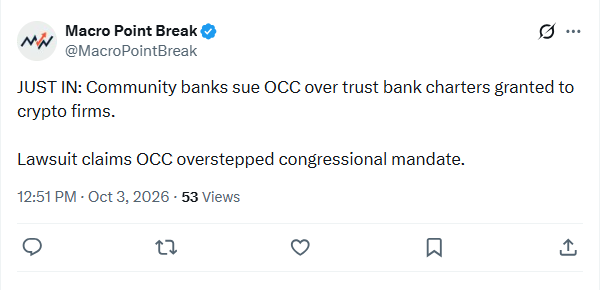
Source: Macro Point Break
ICBA President and CEO Rebeca Romero Rainey said Congress did not establish the national trust charter as an alternative route for crypto companies seeking a federal bank charter. She pointed to requirements including Community Reinvestment Act obligations, consolidated supervision, capital and liquidity standards, and FDIC insurance.
The OCC had been asked to comment on the lawsuit but had not responded by the time of publication, according to the supplied material.
The dispute also concerns the treatment of customer deposits. The national trust charters described in the material do not provide FDIC insurance for consumer deposits while allowing approved firms to offer services such as asset custody and settlement across the United States.
ICBA argues that this creates a regulatory difference between community banks and crypto firms operating under national trust charters. The banking group also said the structure could create risks for financial markets.
OCC Approvals Expand the Crypto Banking Dispute
The lawsuit follows a series of OCC approvals and conditional approvals involving crypto and fintech companies under the administration of President Donald Trump and OCC head Jonathan Gould.
The companies identified in the supplied material include Ripple, Circle, Paxos, Fidelity Digital Assets, Revolut and Trump-backed World Liberty Financial. Coinbase has also received a national trust bank charter, according to the material, while Circle secured an OCC charter in July.
These approvals have drawn opposition from parts of the traditional banking sector. In May, Sen. Elizabeth Warren and other Democrats joined criticism of the OCC’s charter approvals.
Crypto industry representatives have disputed the banking sector’s position. The Digital Chamber argued that crypto companies were seeking regulatory frameworks suited to the services they provide rather than attempting to avoid oversight.
Gould has also rejected the argument that the OCC should protect established banks from competition. He said his role was not focused on incumbent protection.
ICBA Lawsuit Part of Larger Bank vs. Cryptocurrency Controversy
The lawsuit by ICBA is another part of a larger dispute between banks and cryptocurrency firms regarding the availability of financial services and the regulation of digital currencies.
ICBA had previously objected to the CLARITY Act, claiming that the proposed bill could lead to deposit outflow from community banks. The supplied material also links the dispute to disagreements over stablecoin yields and other crypto-related banking issues.
The OCC’s charter decisions have therefore become an additional point of contention between the two industries. ICBA maintains that companies conducting non-fiduciary activities should meet the same standards as community banks when seeking the benefits associated with federal bank charters.
The case now puts the OCC’s approach to national trust bank charters before a federal court. The lawsuit seeks to have the challenged rule and interpretive letter vacated.
FAQs
What is the ICBA suing the OCC over?
The ICBA is protesting the OCC’s use of national trust bank charters for crypto and fintech firms, contending that the agency acted beyond its scope of power.
Which crypto companies have received OCC trust charters?
The supplied material identifies Ripple, Circle, Paxos, Fidelity Digital Assets, Revolut, World Liberty Financial and Coinbase among the companies that have received or been conditionally approved for such charters.
Do the national trust charters include FDIC insurance?
The charters described in the material do not provide FDIC insurance for consumer deposits.