Key Insights
- Brazil B3 and Six Banks Launch Open BRL Stablecoin
- The Brazilian B3 have unveiled a group of 6 banks that will back the Open BRL.
- The B3 Targets Tokenized Markets with Open BRL Stablecoin.B3 Targets Tokenized Markets With Open BRL Stablecoin.
Brazil’s B3 and Six Banks announce the launch of the Open BRL Stablecoin.Brazil’s B3 and Six Banks announce the launch of the Open BRL Stablecoin.
Brazil’s B3 and Six Financial Institutions to Launch Real-Pegged Stablecoin in Q1 2027
According to Valor Econômico, Brazilian stock exchange B3 has partnered with Bradesco, BTG Pactual, Itaú Unibanco, Safra, Santander and XP to launch Open BRL in Q1 2027. Issued by Banco B3 and… pic.twitter.com/f67H0Qziaw
— Wu Blockchain (@WuBlockchain) November 27, 2026
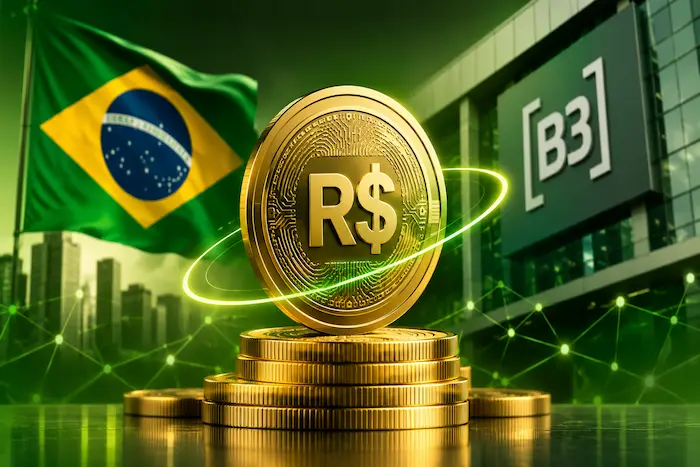
The Brazilian real-backed stablecoin, called Open BRL, will be introduced by Brazil’s stock exchange operator B3 and the country’s six leading banks in the first quarter of 2027. The project is designed to provide common blockchain infrastructure for institutional payments and digital asset settlements in the largest economy in Latin America.
On November 27, Valor Econômico confirmed that Bradesco, BTG Pactual, Itaú Unibanco, Safra, Santander and XP are part of the partnership. The institutions will provide the funding for development, and incorporate the stablecoin into their digital asset applications.
Project tackles a key issue in Brazil’s financial sector. Banks have been working on their own blockchain projects and incompatible stablecoins make it difficult to complete transactions between competing banks.
B3 and Banks set up common Stablecoin Infrastructure.
The institutions began talking about it about three months ago. They also understood that banks might have issues accepting individual stablecoin transfers.
Open BRL will be the settlement currency, providing a common settlement language, and banks will be able to have their own token for operations.
According to Luiz Masagão, vice president of products at B3, the programme is designed to benefit the whole financial market in Brazil. More financial institutions will be allowed to use it when it is used.
The stablecoin will be issued by Banco B3, which will keep reserves equivalent to the number of tokens. They will also be able to exchange their tokens for the base currency.
In the meantime, B3 will be responsible for technology infrastructure. A committee of representatives from participating institutions will determine governance rules, technical standards and pricing.
The partners have not announced the amount of their financial commitments. But as more people join as participants, they may eventually develop their own company to manage the platform.
Bill for the sale of tokens that represent assets is open and digital. Digital and open Bill for sale of tokens representing assets.
Open BRL Targets Tokenized Asset Settlements
In addition to institutional payments, Open BRL will also back B3’s security trading plans using blockchain technology.
The exchange is building a platform for traditional financial assets to be digitally represented, such as equities. These tokenized assets will be settled in Open BRL.
In addition, blockchain transfers may also trigger smart contracts that automatically execute predetermined settlement instructions.
B3 previously announced its plans to expand its digital asset presence in December 2025. The exchange will aim to interoperate the blockchain services with its trading and post-trading platforms.
In order to be used for transactions, there needs to be some kind of “reliable payment instrument” for tokenized assets, Masagão said.
This means that Open BRL could support financial institutions to move payments along with digital securities via a common settlement network.
USDT Dominates Brazil’s Stablecoin Market
Open BRL is entering a market where stablecoins constitute around 80% of the trading volume of cryptocurrencies.
The tax authority Receita Federal reported approximately R$1.13 trillion worth of transactions with stablecoins between August 2019 and December 2025. That was done by Tether’s USDT at 88.7% followed by USDC at 7.1% and BRZ at 3.4%, which is backed by the Brazilian real.
In May 2026, Fintrender counted over 10 stablecoins backed by real assets that have a combined circulating supply of more than $140 million. Other projects are related to BRL1 that was issued by a consortium made up of Mercado Bitcoin, Foxbit, Bitso and Cainvest.
Dollar-backed tokens, however, still reign supreme in Brazil’s stablecoin scene. Open BRL can help development of domestic alternatives by offering a common settlement asset to financial institutions.
Brazilian Regulators are aware of the initiative.
Open BRL is being developed under the regulatory framework already in place in Brazil, by B3 and its partners.
The Central Bank of Brazil has learned about the project, said Masagão. He further pointed out that the Securities and Exchange Commission (CVM) is also backing the initiative due to its association with the tokenization of financial assets.
The Central Bank Resolutions 519, 520 and 521 were only introduced in Brazil in November 2025. The rules went into effect in February 2026, setting out the authorization process and standards for cryptocurrency service providers. In addition, some transactions with stablecoins are subject to foreign exchange laws.
Additionally, starting July 2026 Brazil’s DeCripto framework imposed reporting obligations for qualifying cryptocurrency service providers.
As a result, Open BRL is entering a more regulated digital asset market. For it to be successful, it will need to be institutionalized, compliant with the regulations and embedded in the existing financial systems.
B3 anticipates that the platform will be up and running in Q1 2027. The model of sharing settlements it has could help bridge the gap between traditional financial institutions in Brazil and the growing tokenized asset market.