Key insights
- Separate negotiations: The five directors are now responsible for different committees to consider the proposed $3.5 trillion merger.
- Rising market expectations: Kalshi had the February 2027 contract at 55%, which is in line with the growth in interest in a potential deal.
- Musk’s control: Regulatory hurdles, such as shareholder voting and national security concerns, could make the deal more complicated.
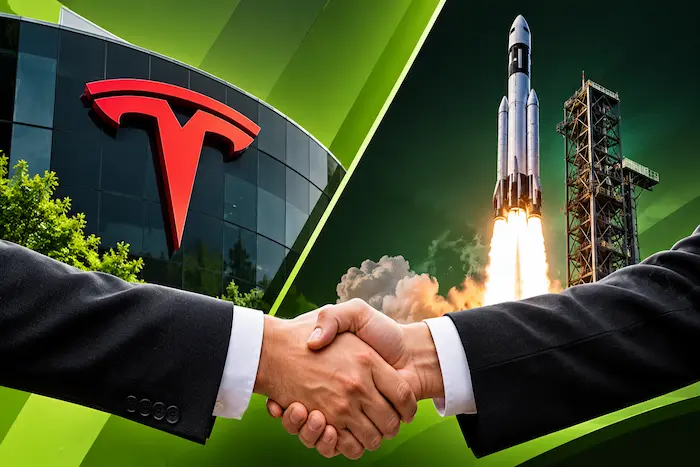
A merger between Tesla and SpaceX moved a step closer after the two companies named five directors to supervise a possible $3.5 trillion all-stock deal. Before the end of 2026, the separate committees are negotiating terms, as outlined in the Financial Times report from November 24, 2026. The development also continued to raise the bar on prediction market forecasts, with Kalshi traders giving a 55% probability of a deal prior to the end of February 2027.
BREAKING: Tesla and SpaceX advance merger talks, tapping five directors to negotiate a deal that could create a $3.5 TRILLION company, per FT.
Each board formed its own negotiating committee. Tesla named 3 directors and SpaceX named 2, all deemed to have no conflicting financial…
— Coin Bureau (@coinbureau) November 24, 2026
Five directors take control of negotiations
The proposed merger has become the subject of special committees to review at Tesla and SpaceX. Tesla hired Robyn Denholm, Kathleen Wilson-Thompson and Jack Hartung to advocate for its cause. Botha and Randy Glein were chosen by SpaceX to run the negotiations on its side.
The committees will review the financial health of the companies, as well as possible business synergies and transaction structure. They will develop financial models and make the decision about the ratio of shares to be exchanged. However, negotiations are still going on, and at this time, the companies have not yet made any announcement about the conditions of the agreement.
The companies also appointed major financial institutions to advise on the transaction. Morgan Stanley and Goldman Sachs are working with SpaceX, while Evercore advises Tesla.
The proposed structure would combine the companies through an all-stock transaction. Earlier estimates suggest Tesla shareholders could receive approximately 0.7 SpaceX shares for each Tesla share. Under that arrangement, existing Tesla investors would own roughly 40% of the combined business.
The valuation is based on the estimated valuation of Tesla, which is $1.45 trillion, and the valuation of SpaceX, which is approximately $2.06 trillion. All of those numbers combine to make a potential transaction of almost $3.5 trillion.
Musk’s position creates governance challenges
Elon Musk will not be directly involved in the negotiations, as he is the CEO of both companies. The participation in discussions could cause conflicts of interest among the shareholders of Tesla and SpaceX.
The independent committees will then be responsible for the negotiations and review of terms proposed. But Musk’s stance is still important because he owns both companies.
A press release on Tesla’s Oct. 22 filing suggested that any deal with SpaceX will still need the thumbs-up from Musk in his majority stake. His influence would therefore continue to be vital even though he doesn’t necessarily be involved in negotiations.
Musk previously discussed the possibility of combining his businesses during SpaceX’s third-quarter earnings call. He described bringing artificial intelligence, robotics, electric vehicles and aerospace operations under one corporate structure as a good idea.
His broader strategy involves integrating technologies and operations across several industries. Nevertheless, shareholders would still need to evaluate whether the proposed combination benefits both companies.
Kalshi traders increase merger expectations
The announcements of the 5 appointments sparked more speculation on prediction markets. In the days leading up to the market tracking of Tesla and SpaceX possibly merging, Kalshi’s market tracking had higher probabilities on a number of dates.
The contract for a deal prior to February 1, 2027, climbed up seven points to 55%. At the same time, the month of March contract rose for 6 percentage points to 62%.
The April 1 contract was at 62%, but one percentage point lower. The market had traded around $1.97 million worth of shares.
The figures suggest growing interest from traders after formal negotiations, which has led to a rise in volume. Prediction market prices, on the other hand, are not a confirmation of a soon-to-be transaction, but rather market expectations.
Earlier, Barclays analyst Dan Levy suggested that the companies could announce a deal within weeks. He expected a possible announcement before Tesla’s annual shareholder meeting.
Tesla subsequently scheduled its shareholder meeting for December 3. However, the published agenda does not include a merger resolution, meaning shareholders will not vote on the transaction during that meeting.
HSBC also raised its Tesla price target to $359 from $157. The bank cited a potential valuation premium associated with a SpaceX combination.
Regulatory scrutiny could complicate the deal
The proposed combination will encounter major regulatory and geopolitical hurdles beyond shareholders’ approval. SpaceX has key defense contracts in the United States, and Tesla relies heavily on its manufacturing and business activities in China.
The merger of these enterprises may prove problematic for regulators in the United States, China, Europe and the United Kingdom. The review process may be complicated due to national security issues concerning rocket technology and satellite infrastructure.
Ownership structure is also important to consider. SpaceX has about 84% of the voting power of the company, held by Musk, while he has about 20% of the voting power at Tesla.
As such, the deal could significantly alter the control of the entity. Tesla would also require a separate extraordinary meeting to grant the approval of shareholders. If the voting requirements are reported, over half of the possible votes need to be in favor of the proposal.