
Key Insights
- Reporting remains central. There are enforcement and fairness issues due to limited access to overseas transaction data.
- Investors can experience some respite. The proposed tax burden is delayed if it is launched in 2029, as this will still require Parliament to give it its approval.
- Regulatory uncertainty persists. The procedures for airdrops and decentralized finance transactions are still to be worked out.
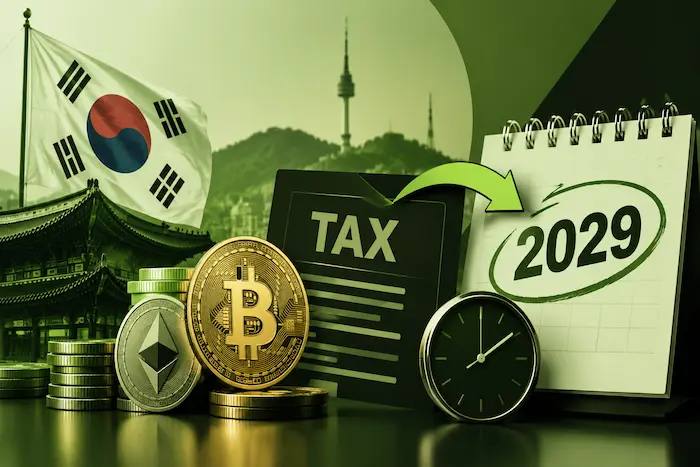
South Korea crypto tax plans face another delay as the presidential office backs moving the 22% levy from January 2027 to 2029. The proposal shows that overseas reporting gaps are still not solved. Investors are worried. There are questions, about whether authorities can enforce the tax fairly.
South Korea reconsiders its crypto tax timeline
In 2020, South Korea enacted a new amendment to the Income Tax Act that imposes tax on cryptocurrency income. The deadline was initially set for January 2022, but was delayed by industry concerns and objections.
Subsequent revisions moved the start date to 2023, 2025 and January 2027. Now, ruling-party lawmakers are considering another postponement until January 2029, which would mark the fourth delay since the original legislation.
According to an October 25 report, a presidential official confirmed that discussions had shifted toward postponement. The official cited inadequate preparations and difficulties obtaining transaction information from overseas cryptocurrency platforms.
The existing framework proposes a combined 22% tax on qualifying annual cryptocurrency gains exceeding a 2.5 million won allowance. The rate comprises 20% national income tax and 2% local income tax.
For example, an investor earning five million won in qualifying annual gains would owe 550,000 won after deducting the allowance. However, the proposed delay would give investors more time before these obligations begin.
Overseas reporting gaps complicate enforcement
The government’s biggest hurdle is to monitor transactions of cryptocurrencies done via foreign exchanges and privately owned wallets. With poor information, the authorities might not be able to accurately determine gains and report them consistently.
South Korea plans to take part in information exchanges through the Organisation for Economic Co-operation and Development’s Crypto-Asset Reporting Framework or CARF. This framework enables countries that join to share details about cryptocurrency accounts and transactions. South Korea is joining this effort to keep up with standards, for financial transparency.
However, the presidential office has highlighted the United States’ planned participation from 2029. Officials believe the timing could complicate enforcement if South Korea introduces taxation earlier without sufficient access to overseas transaction records.
Thus, domestic exchange traders may be under more stringent regulation than foreign traders. This distinction could jeopardize the confidence in the tax system and lead some traders to relocate trading to offshore locations.
The South Korea crypto tax delay would give more time for preparation, but this would not necessarily solve these reporting issues. Authorities have yet to find effective ways to identify transactions that are subject to tax and to determine the liability of investors.
Domestic exchanges face continued uncertainty
The delay also applies to major exchanges such as Upbit and Bithumb in the country.The delay applies to major exchanges in the country as well, including Upbit and Bithumb. Investors and exchanges should have greater clarity on the reporting requirements, especially in relation to complicated digital asset operations.
On October 20, government officials were scheduled to meet representatives from five major cryptocurrency exchanges. Discussions focused on implementation challenges, including the treatment of staking rewards, airdrops and decentralized finance transactions.
South Korea’s planned tax reporting guidelines were expected in November. Meanwhile, the National Tax Service continued preparing systems to identify taxable activity under the existing timetable.
Industry representatives have warned that inconsistent reporting requirements could disadvantage domestic exchanges. They also argue that premature implementation could push trading activity toward foreign platforms with different reporting arrangements.
Younger investors have become another consideration in the debate. Presidential officials have described cryptocurrency investments as one avenue through which younger people seek to build personal wealth.
A Gallup Korea survey conducted from October 20 to 22 found declining presidential approval among voters in their twenties and thirties. However, the survey did not establish that cryptocurrency taxation caused the decline.
Parliament holds the final decision
The ruling Democratic Party has introduced a bill that suggests a January 2029 start date. This plan would allow regulators more time to upgrade reporting systems and work closely with partners.
The opposition People Power Party has also backed the idea of delaying the implementation. Still some members of the People Power Party have pushed for a later date or even the complete repeal of the policy. Even though both parties share concerns, about the timeline they do not fully agree on how to move.
Democratic Party leader Kim Min-seok previously said the issue needed resolution within the year, according to October 25 reporting. The presidential office is expected to consult with the government and ruling party after October’s parliamentary audit.
Lawmakers could consider amendments during November’s tax law review. Nevertheless, the current legislation remains unchanged until Parliament approves a formal revision.
With the South Korea crypto tax delay, therefore, it is not a guaranteed change in the legal deadline but merely a proposal. Investors and exchanges need to keep watching changes in the laws before they make any changes to their compliance plans.
Conclusion
The proposed postponement in South Korea reflects a mix of political and investor concerns. Both major parties in South Korea back some form of delay. The lawmakers in South Korea must decide the final timeline.
Until Parliament, in South Korea approves an amendment, January 1 2027 remains the scheduled implementation date.