
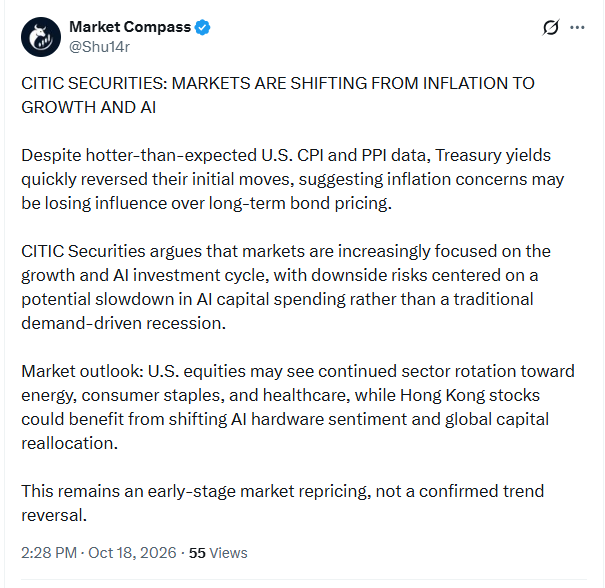
CITIC Securities said U.S. Treasury markets are showing a weaker response to inflation data as investors place greater emphasis on economic growth and the artificial intelligence (AI) investment cycle.
The assessment came after September inflation numbers released in October, where there were price increases of 3.7 percent for consumers and 6.3 percent for producers, which were higher than expected.
Despite the higher numbers, the response of the 10-year Treasury yield to these numbers was not strong after 24 hours, thus calling into question what drives bond prices.
The firm’s research report also identified the possibility of a downturn in AI capital expenditures as a source of recession risk reflected in long-term market pricing. It distinguished this risk from a conventional recession driven by weakening consumer demand and said the two dynamics could coexist with stagflation.
However, the report cautioned that the current pricing pattern remains tentative and does not yet establish a confirmed market trend.
CITIC Securities Identifies a Shift in Treasury Market Pricing
The 10-year U.S. Treasury yield initially climbed after the September consumer price index (CPI) report was released on October 14. It rose approximately 13 basis points to 5.325% before reversing direction and closing lower.
Source: Market Compass
The next day, however, the producer price index (PPI) announcement didn’t move markets much. The 10-year yield rose by about 2.5 basis points following the publication of the data on October 15, whereas the 30-year Treasury yield fell.
Moreover, the 10-year yield then fell back to 5.048%. According to CITIC Securities, the pattern of events indicates that higher than expected inflation figures have a decreasing impact on the Treasury yields.
One basis point is one hundredth of a percentage point. This term is mostly employed when dealing with interest rates and bond yields. This means that an increase of 13 basis points represents 0.13 percentage points.
The contrast between the initial reaction to CPI and the more limited movement after PPI formed part of the firm’s assessment. CITIC Securities noted that the focus should be on the move towards economic growth expectations rather than considering the inflation data as the sole determinant for long-term yields.
AI Capital Expenditure Becomes a Source of Recession Risk
According to CITIC Securities, the risk of a recession that is embedded in long-term pricing is related to the risk of a downturn in the capital expenditures related to the AI investment cycle. This scenario is different from the traditional recession, where weak demand leads to an economic recession.
This is important for the interpretation of the report since the report considers the possibility of such a risk to be linked to investment around AI and not just the demand. The report also mentions that such a risk could be existing alongside stagflation, which is linked to persistent high inflation along with weak economic growth.
However, the report does not refer to such an AI investment downturn as a proven one. The report only considers the current market pricing to be exploratory.
The Treasury yield changes provide the immediate market context for that assessment. Inflation readings exceeded expectations, yet the 10-year yield’s gains faded and the longer-dated 30-year yield fell after the PPI release.
CITIC Securities interpreted this behavior as evidence that the pricing anchor for longer-term bonds is moving toward the growth and AI cycle. Its assessment remains a market interpretation rather than confirmation that investors have fully abandoned inflation concerns.
U.S. Stocks May Experience Further Sector Rotation
The report also outlined potential implications for U.S. equities. CITIC Securities said sector rotation could continue in the short term, with capital shifting away from AI-related themes toward energy, defensive consumer staples and health care
The company attributed the possibility of such a shift towards the industries to the expected victory of Democrats in the midterm U.S. elections. The industries were identified as the beneficiaries of the expectation, although there was no confirmation on the actual occurrence of the political event, let alone the actual rotation of capital.
The assessment places sector allocation alongside changing Treasury market pricing as an area to watch. However, the report’s description of the current environment remains tentative, and its comments on potential stock market movements should not be read as confirmation of future performance.
Hong Kong Stocks Face AI Hardware and Index-Related Factors
CITIC Securities also identified two factors that could affect Hong Kong equities. One is a reversal in overseas trading involving AI hardware, while the other concerns portfolio adjustments associated with the possibility of Indonesia being removed from the MSCI Emerging Markets Index.
The report said Hong Kong stocks could benefit from both developments. However, it did not establish that Indonesia’s removal from the index had been confirmed or quantify the potential effect of related portfolio adjustments.
These factors broaden the report’s focus beyond U.S. Treasury yields and domestic equity sector rotation. At the same time, they underscore the difference between market changes observed and those that might occur in light of the future events.
For now, according to the CITIC Securities main view, long-term market pricing puts less weight on inflation numbers and more on growth and AI risks. The firm emphasized that this shift remains unconfirmed.
Key Takeaways
- CITIC Securities said Treasury market pricing is shifting toward growth and AI investment risks as inflation-driven yield gains fade.
- The report identified a potential AI capital expenditure downturn as a recession risk that can coexist with stagflation.
- U.S. sector rotation and possible portfolio adjustments affecting Hong Kong stocks remain conditional market developments rather than confirmed outcomes.