

KEY INSIGHTS
- The digital euro will be used alongside cash for retail payments in Europe while the ECB makes its preparations.
- Inflation in euro area was 3.8% in September, and energy prices could keep it higher than the ECB target till 2027.
- The ECB launched Pontes for tokenized asset settlements, and full implementation is expected by 2028 across financial institutions.
Christine Lagarde, President of the European Central Bank (ECB), stated that the bank is moving forward with preparations for its digital euro currency used for daily transactions, while inflation in the euro zone reached 3.8% in September due to rising energy prices.
In her address at the International Monetary Fund’s yearly gathering on October 17, Lagarde noted that inflationary pressure from energy prices would remain above the target of the bank till mid-2027.
The remarks placed the ECB’s retail payment initiative alongside its response to continuing price pressures. Lagarde maintained that a measured monetary policy response remains appropriate, while the central bank works on a digital form of money intended to complement physical cash rather than replace it.
The digital euro is designed for day-to-day transactions. According to Lagarde, the project also aims to encourage competition and innovation in retail payments while supporting Europe’s strategic autonomy in payment services.
Digital Euro Preparations Focus on Everyday Payments
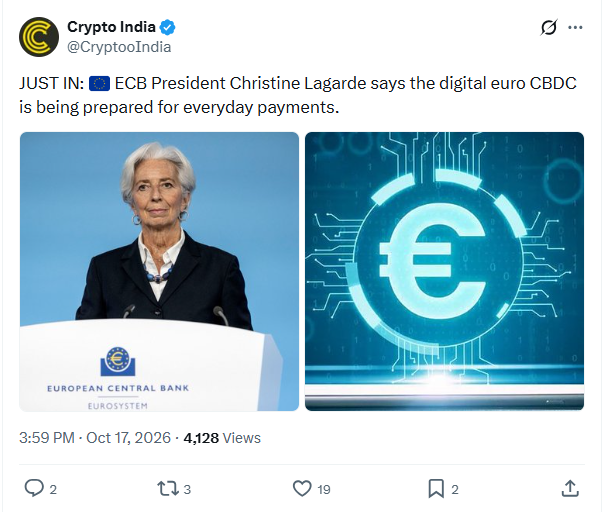
ECB is designing the digital euro as the digital form of cash used for retail purposes. According to Lagarde, it will enable consumers to have an additional means for making payments while retaining the existence of both public and private forms of payment services.
Source: Crypto India
In her speech delivered on October 17, she mentioned that the digital euro will further fuel innovation and competition in retail payments. She also linked the continued availability of public and private solutions to Europe’s strategic autonomy in payments.
The ECB’s stated approach does not involve replacing cash. Instead, the proposed digital currency would complement existing physical money with a digital option for everyday use.
Nevertheless, the provided statements do not mention a date of release for the digital euro or give more information on the timeline for its introduction.
Energy Prices to Keep Inflation Higher than ECB Target
Inflation in the Euro area was 3.8% in September, with Lagarde crediting the increase mainly to rising energy prices. The ECB sees these prices falling in the coming year, but the anticipated energy shock is projected to keep inflation higher than the target until the first six months of 2027.
The inflation rate remains above the ECB’s 2% target, according to the supplied reporting. Lagarde nevertheless said a measured policy response remains appropriate under the circumstances.
Her remarks suggest that the central bank is analyzing the pressures for inflation while continuing with their monetary policy approach. The projected easing in energy prices will not translate to an immediate drop in inflation to the target of the ECB, since the bank expects the consequences of the energy shock to carry on until 2027.
The resilience of the euro area economy was another comment made by Lagarde. Her remarks connected the inflation outlook with the ECB’s continuing work on payment infrastructure, without suggesting that the digital euro would directly resolve the region’s price pressures.
Pontes Brings Central Bank Money to Tokenized Settlements
The ECB has also introduced Pontes, a separate initiative focused on institutional financial transactions. Launched in September, the system allows financial institutions to settle tokenized asset transactions using central bank money.
Pontes focuses on wholesale settlement rather than retail payments. It comes with an array of services that are available once the system is first rolled out, with complete rollout expected by 2028.
Moreover, the system is also a replacement for the use of private settlement instruments like stablecoins in the process of transacting through it. This makes Pontes different from the digital euro that Lagarde described as a digital version of cash for retail payments.
Together, the initiatives cover different parts of the payment system. The digital euro is being prepared for daily consumer transactions, while Pontes enables financial institutions to settle tokenized assets using central bank money.
The two projects therefore have distinct stated functions, despite sharing the ECB’s focus on public money in digital payment and settlement arrangements.
ECB Balances Payment Plans With Inflation Pressures
The ECB’s digital euro preparations are continuing as the central bank monitors an inflation rate that remains above its target. Lagarde’s October 17 remarks reaffirmed the intended role of the digital euro as a complement to cash and highlighted competition, innovation and European strategic autonomy in retail payments.
Meanwhile, the inflation outlook remains tied to energy costs. The ECB expects those pressures to ease next year, although Lagarde said inflation could remain above target through the first half of 2027.
Pontes adds a separate institutional settlement component to the ECB’s work, with full implementation expected by 2028. The digital euro and Pontes have different purposes, but both involve the central bank’s efforts to support the use of central bank money in digital financial transactions.
FAQs
What is the digital euro?
A digital euro is an envisaged digital version of central bank money meant to complement cash as a means for retail payments.
Why is the ECB preparing a digital euro?
Lagarde said it would support innovation and competition in retail payments while helping preserve Europe’s strategic autonomy in payments.
Why did euro-area inflation reach 3.8% in September?
Lagarde said September’s inflation rate largely reflected higher energy costs, which the ECB expects to ease next year.