
Key Insights
- Inflation remains the primary risk. Another upside surprise could strengthen expectations of prolonged restrictive policy.
- Retail sales need to be looked at more carefully. Any gains in spending that result from fuel will overestimate underlying consumer demand.
- Don’t assume that fund outflows are indicative of a continuing decline. Economic signals are still needed before investors can set up a market direction.
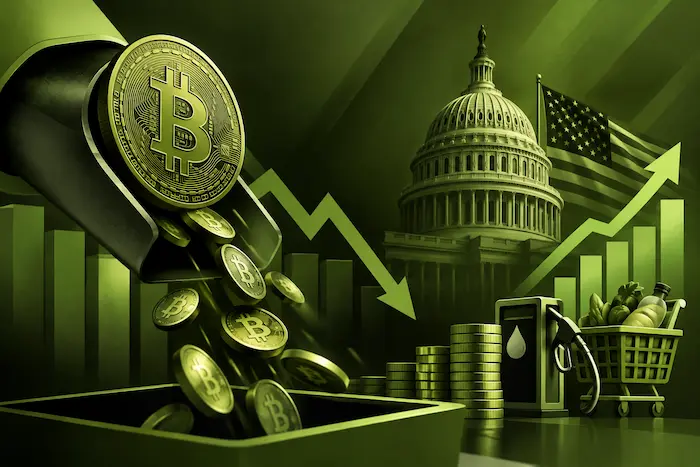
Bitcoin faces renewed selling pressure as global digital asset investment products record $434 million in weekly outflows through October 16. CoinShares linked the withdrawals to stronger US inflation and retail sales, which have increased concerns about prolonged Federal Reserve tightening and weakened investor appetite for risk-sensitive assets.
The latest economic figures complicate the outlook for cryptocurrency markets. Although traders still favor an interest rate pause at the October meeting, expectations for another increase before year-end have strengthened.
US Inflation reignites concerns over monetary policy
September consumer inflation accelerated to 3.7% annually, exceeding the market forecast of 3.6%, according to the US Bureau of Labor Statistics. Monthly consumer prices increased by 0.6%. Gasoline prices jumped by 9.1% and gasoline accounted for about half of the headline increase. Core CPI, which excludes food and energy rose by 0.3 % monthly. By 2.6% annually. The figures suggest underlying price pressures remain persistent despite earlier efforts to contain inflation.
CoinShares: Hot CPI Drives $434M Digital Asset Fund Outflows
CoinShares said U.S. September CPI rose 3.7% year-on-year, above the 3.6% forecast, while retail sales increased 0.8% versus 0.3% expected. The stronger data pushed rate expectations more hawkish, with global digital… pic.twitter.com/YdVvlmxpTS
— Wu Blockchain (@WuBlockchain) October 16, 2026
As a result, investors are re-evaluating the quest for interest rate cuts. Rising borrowing costs can lead to better returns on interest earning assets and raise the opportunity cost of having cryptocurrencies which do not provide regular income.
CoinShares said it did so this week due to a shift in the monetary outlook. The firm cautioned against the prospect of continued inflation, which would make it harder for the Fed to loosen financial conditions.
Strong retail sales complicate the fed’s decision
US retail and food services sales went up by 0.8% in September, which was higher than the 0.3% according to data released by the Census Bureau on October 15. The August number was also revised upward to 1.3% showing that consumer demand remains strong despite economic uncertainty.
The rise in sales was heavily influenced by higher fuel prices. Gasoline station sales jumped 6.4% in September. When you remove gasoline from the equation retail sales only grew by 0.2% down from 1% in August.
This difference is important. A rise in sales doesn’t always mean people are buying more. It can simply mean prices are higher. If households buy the amount of goods but at higher prices sales figures will go up even if consumption stays flat.
So the latest numbers create signals, for the Federal Reserve. On one hand spending is weak. Inflation remains stubbornly high. That suggests the Fed should keep policy loose. On the hand there are signs that consumers are still spending, which could support economic growth. These competing pressures make it harder to decide the move.
The key developments include the following.
- Investors’ appetite for global digital asset investment products decreased, with weekly outflows recording $434 million.
- The inflation reading was higher than expected. Inflation for September rose to 3.7 percent versus the 3.6 percent forecast.
- Consumer spending stayed strong. Retail sales rose 0.8 percent compared with the forecast of 0.3 percent.
These figures together indicate that investors are still uncertain, about the policy moves of the Federal Reserve.
Bitcoin Outlook Depends on Incoming Economic Data
CoinShares said the short-term scenario is tough on cryptocurrencies but did not specify a trend. The firm anticipates that investors’ positioning and price volatility will be impacted by the upcoming inflation and economic activity reports.
That sensitivity to monetary policy is at the very heart of the assessment of Bitcoin. Rising real yields will lower the demand for non-yielding assets and tighter financial conditions will curtail supply of capital for speculating on assets.
However, if the economy slows down or if there is more clear signs of cooling inflation, then the market sentiment will be better. Developments on either side would help ease the Fed’s pressure to keep rates high.
CoinShares expects Bitcoin to trade within a data-driven range in the near term rather than follow a clearly established trend. Investors might thus focus on strategic allocation rather than taking reactions to individual economic reports.
Conclusion
Bitcoin is facing a challenging macro economic scenario along with inflation and consumer spending, which are all impacting Fed policy. This week saw the investment products pull out $434 million, underscoring the volatility of the market in response to shifts in rate expectations.
But these withdrawal periods are not enough to draw a significant bearish trend. Whether the pressure mounts or conditions improve will depend on the future inflation readings, consumer demand and decisions by the Federal Reserve.