
KEY INSIGHTS
- Qivalis has already received Dutch EMI permission but has to comply with MiCA before it can launch its euro stablecoin.
- The 37-bank consortium is set to release its token via the banks and the exchanges upon satisfying regulatory requirements.
- Qivalis is required to release a white paper prior to launching but there have been no details on transaction volumes and banks involved.
Qivalis, a consortium of 37 European banks, has been allowed to perform any activity that electronic money institutions may carry out from De Nederlandsche Bank (DNB), thus overcoming its biggest hurdle while launching its euro-based stablecoin. The Amsterdam-based startup announced the news on October 14, 2026, when it is all set to launch its electronic money token (EMT) in line with the MiCA rules.
The license allows the firm to issue the electronic money, but that doesn’t mean that the token is ready to be launched. It is only after fulfilling all MiCA criteria, including creating a whitepaper, that the issuing can start. Qivalis expects to launch the token in the coming months.
The project aims to give banks and payment companies a way to transfer euros on-chain through a regulated settlement instrument. Rather than distributing the token directly to individual consumers, Qivalis plans to work through banks, cryptocurrency exchanges, payment service providers, and other eligible institutional intermediaries.
Qivalis Euro Stablecoin Still Requires MiCA Compliance
The DNB authorization addresses a central regulatory requirement for Qivalis, allowing the company to proceed toward issuing its planned EMT. The firm will remain under DNB supervision following its approval as an electronic money institution.
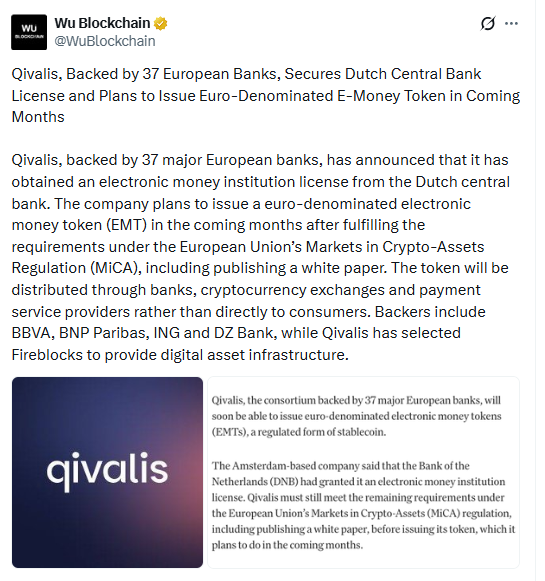
Source: Wu Blockchain
However, authorization of the issuing entity is only one part of the process. Qivalis must complete its outstanding obligations under MiCA and publish the token’s white paper before issuance can begin. The company has not announced a specific launch date beyond its plan to issue the token in the coming months.
Qivalis has said that regulatory compliance has been part of its design from the outset. With the Dutch license secured, its remaining preparations are focused on the requirements governing the token itself rather than obtaining authorization for the issuing entity.
The distinction matters because an EMI license does not, by itself, establish that every requirement for offering a particular token has been completed. Qivalis still needs to meet the applicable European rules before bringing its euro-denominated EMT to market.
How MiCA Rules Apply to Electronic Money Tokens?
MiCA distinguishes electronic money tokens from other forms of stablecoins. An EMT must be pegged to a single official currency, such as the euro or the U.S. dollar. Other stablecoins may instead be linked to baskets of currencies or different assets.
Regulatory classification imposes certain obligations on the parties to the contract. The EMT should have a single official currency pegged to it, like the euro or US dollars. There are other stablecoins that can be pegged to baskets of currencies or other assets. The holder has a right of legal claim from the issuer and the possibility to redeem tokens on demand at par value.
EMTs cannot generate interest income. Dollar-denominated stablecoin such as USDC may become an EMT in the EU if it complies with necessary conditions. The issuer who does not comply with required rules has no right to offer tokens to the public in the bloc.
From the point of view of Qivalis, the above-listed regulations form the regulatory framework for euro settlement instrument. The company has positioned the project as an effort to establish an onchain asset issued under European law and subject to European regulatory standards.
Thirty-Seven Banks Back Qivalis Distribution Plans
Qivalis has assembled a consortium of 37 banks from 15 countries since its founding in September 2025. Participants include BBVA, BNP Paribas, ING, and DZ Bank, giving the project a network of established financial institutions behind its planned issuance and distribution model.
The consortium has also selected Fireblocks to provide digital asset infrastructure. The partnership forms part of the technical arrangements supporting the bank-backed stablecoin initiative.
Qivalis intends to make the token available through institutional distribution partners instead of serving consumers directly. Its proposed counterparties include banks, exchanges, payment providers, and market infrastructure participants.
However, the company has not disclosed which consortium members will use the token or how much transaction volume they expect to process through it. The available information therefore establishes the consortium’s size and planned distribution channels, but not the level of usage after launch.
European Onchain Settlement Remains the Stated Goal
Qivalis CEO Jan-Oliver Sell said the company believes Europe should have a euro-denominated on-chain settlement asset issued under European law and subject to European regulatory standards.
The statement reflects the company’s stated objective of placing euro-based settlement within a European regulatory framework as financial activity moves on-chain. The DNB authorization brings the issuer closer to that goal, while the remaining MiCA obligations continue to determine when the token can be released.
The Qivalis euro stablecoin has therefore cleared an important licensing stage, but issuance remains conditional on completing the outstanding requirements. The next confirmed steps are compliance with MiCA and publication of the white paper.
FAQs
What is Qivalis?
Qivalis is an Amsterdam-based consortium-backed company supported by 37 European banks that plans to issue a euro-denominated electronic money token.
What license has Qivalis received?
De Nederlandsche Bank granted Qivalis authorization to operate as an electronic money institution.