Sui is preparing to introduce post-quantum cryptography to protect account authentication against potential threats from sufficiently powerful quantum computers.
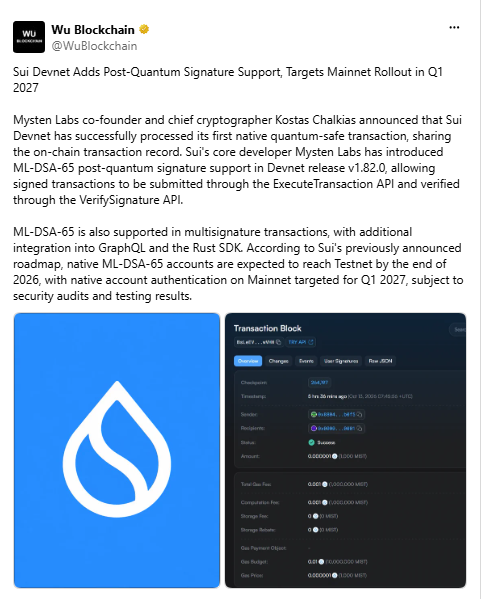
Mysten Labs reported its first native quantum-safe transaction on Sui’s development network on October 12, 2026, following the devnet-v1.82.0 release. ML-DSA-65 has been added as a built-in account signature method with Mainnet adoption aimed at Q1 2027, subject to security reviews and Testnet results.
The Sui post-quantum security upgrade has two separate tracks. Sui plans to use ML-DSA-65 for native account authentication and SLH-DSA-SHA2-128s for high-value vaults built with Move smart contracts. The vaults are targeted for Mainnet in 2026, ahead of the planned account-level rollout.
What Is Sui’s Post-Quantum Security Upgrade?
The upgrade introduces digital-signature methods designed to withstand attacks from sufficiently powerful quantum computers. Blockchain wallets rely on cryptographic signatures to authenticate transaction authorization, and thus a compromised signing key will enable attackers to authorize any transaction.
Source: Wu Blockchain
An adequately powerful quantum computer that runs Shor’s algorithm can compromise public key cryptography systems by extracting private keys from their corresponding public keys.This remains a future security concern rather than evidence that quantum computers can currently compromise Sui’s Mainnet accounts.
Sui’s implementation uses ML-DSA-65, a lattice-based digital-signature algorithm standardized by the U.S. National Institute of Standards and Technology under FIPS 204. NIST describes the scheme as designed to remain secure against adversaries equipped with large-scale quantum computers. Sui identifies ML-DSA-65 as a Level 3 security scheme.
The October 12 Devnet release introduced the algorithm as SignatureScheme::MLDSA65 = 7 under protocol version 139. The implementation enables validators to verify transactions authorized with post-quantum keys, including standalone signatures and signatures used within multisignature accounts.
Mysten Labs co-founder and chief cryptographer Kostas Chalkias announced the milestone on October 13. However, the specific transaction’s actions and signature could not be independently confirmed from the available SuiVision explorer record. The implementation remains limited to Devnet, where the new signature type is supported.
How Sui Plans to Protect Accounts and Vaults
Sui has selected two cryptographic schemes for different purposes. ML-DSA-65 will support native account authentication, while SLH-DSA-SHA2-128s will protect high-value Move smart contract vaults. The latter is a signature scheme based on hashes, which was standardized according to NIST FIPS 205.
The algorithms are from two different mathematical classes. Thus, the two structures are based on distinct cryptographic systems, although the differentiation does not reduce the risk of potential vulnerabilities in implementation.
| Component | Digital signature scheme | Deployment plan |
| Account identification | ML-DSA-65, lattice-based | Testnet by end of 2026; Mainnet in Q1 2027 |
| Transfer vaults | SLH-DSA-SHA2-128s, hash-based | Mainnet in 2026 |
The Sui Foundation described these deployment objectives in its Quantum Readiness Roadmap released on August 6, 2026. Both projects run independently from one another, and neither project should be considered a fully upgraded network.
What Is Sui’s 2027 Mainnet Plan?
Sui targets the first quarter of 2027 for native ML-DSA-65 account authentication on Mainnet. Before that, the Foundation plans to introduce native account support on the testnet by the end of 2026. Moreover, wallets, SDKs, and command-line interfaces will also be supported alongside the launch.
The schedule is dependent on security audits and testnet feedback so the Q1 goal is more of a hope than a hard launch date Those requirements make the first quarter target a conditional one, not a guarantyd launch date.
The separate vault initiative has a 2026 Mainnet target, making its deployment status another milestone to monitor.
The account upgrade will be opt-in. According to the Foundation, users will be able to derive post-quantum keys from their existing 32-byte seeds and recovery phrases instead of starting with new recovery material. Sui’s address aliases will allow users to change authorized signing keys without moving assets or changing their addresses.
The supplied project information also states that quantum-safe signatures will not incur additional gas fees. However, in order to use the new authentication method, users will require compatible software, and current Mainnet accounts will not have any quantum-resistant capabilities.
What Risks Are Left after the Upgrade?
The post-quantum security upgrade in Sui is designed to tackle certain types of threats for blockchain users, but it doesn’t solve all the problems. Phishing, compromised recovery phrases, malicious smart contracts and implementation vulnerabilities remain separate security concerns.
Post-quantum cryptography can also involve larger signatures and public keys than conventional schemes. The supplied information does not establish the full performance impact of Sui’s implementation, so claims about network-wide efficiency should await supporting measurements.