Key Insights:
- The National Bank must determine whether Tether’s proposed stablecoin model fits existing regulations.
- Kazakhstan must identify the assets and infrastructure for the Alatau tokenization pilot.
- Tether must clarify the token’s issuer, reserves, blockchain and potential commercial structure.
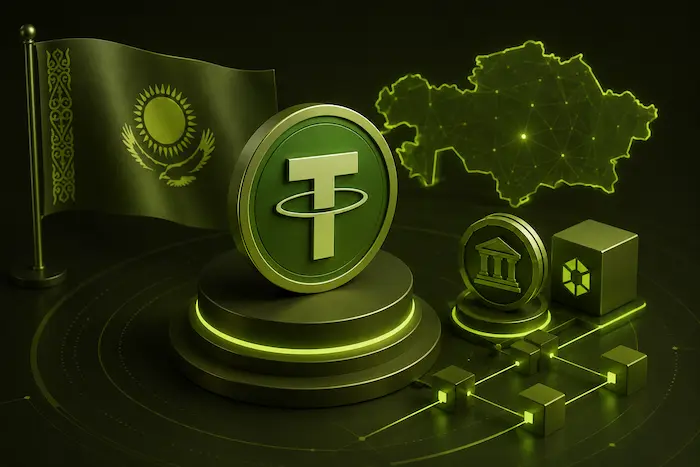
Tether has signed an MoU with Kazakhstan’s National Bank and Alatau City Authority to explore a tenge-backed stablecoin. The Oct. 7 agreement also covers asset tokenization and decentralized finance as Kazakhstan expands its digital-asset framework.
The parties will develop a concept and pilot proposal for a stablecoin linked to Kazakhstan’s national currency. However, the agreement does not approve or launch a new token, and it provides no issuance date.
Tether targets Kazakhstan’s growing digital market
Tether will study stablecoin models used in other markets with Kazakhstan’s National Bank. The parties will assess potential applications and identify infrastructure needed for digital financial products.
They will also examine reserve management, distributed ledger technology and stablecoin operations. Training sessions and workshops will support officials from the central bank and other government agencies.
Tether Signs MoU with the National Bank of Kazakhstan and the Alatau City Authority to Explore Stablecoin Use Cases and Asset Tokenization
Learn more: https://t.co/99Cwo0yiBj— Tether (@tether) October 7, 2026
Tether CEO Paolo Ardoino said digital assets are moving toward sovereign financial infrastructure. He also pointed to Kazakhstan’s work on asset tokenization and strategic digital-asset reserves.
National Bank Deputy Governor Binur Zhalenov said the regulator will study practices during the pilot process. National Bank Deputy Governor Binur Zhalenov said that financial stability, transaction transparency and investor protection remain priorities.
The MoU also covers finance. Decentralized finance could expand the project beyond stablecoin payments.
Kazakhstan already tests tenge stablecoins
The agreement enters an established regulatory market rather than an untested one. Kazakhstan introduced digital-asset rules on May 1 2026 and these digital-asset rules are a major new development.
These digital-asset rules recognize money‑backed stablecoins and tokenized real‑world assets inside Kazakhstan’s financial framework. The digital-asset rules also set requirements, for infrastructure, risk management, compliance and anti‑money‑laundering controls.
Kazakhstan began testing a tenge-backed stablecoin before Tether entered the latest initiative. The National Bank launched its first tenge-denominated stablecoin pilot through its regulatory sandbox in September 2025.
Local exchange Intebix developed the token with Eurasian Bank, Solana and Mastercard. The project, known as Evo or KZTE, aimed to connect digital assets with existing financial services. The new proposal does not explain whether Tether’s project will complement Evo or operate independently. It also does not identify the blockchain or proposed issuer.
Alatau becomes a testing ground for tokenization
Another key element of the deal is asset tokenization. Tether and Kazakhstan will look for asset classes that will work and create a model for the digital issuance of assets.
Its proposed pilot might be conducted in Alatau City under its special legal regime. The parties can also leverage on Hadron, Tether’s platform for issuing and managing tokenized assets.
Hadron has tokens for bonds, equities, funds, stablecoins and commodity-linked assets. But the MoU does not state that Kazakhstan will be using the platform.Alatau has increasingly featured in Kazakhstan’s digital-asset strategy. Authorities have promoted the city as a testing ground for technology, investment and emerging financial models.
The city also has a dedicated development track known as Alatau Crypto City. That initiative focuses on tokenization projects and a broader Web3 ecosystem.
Policy ambitions raise the stakes
Kazakhstan has expanded its digital-asset strategy alongside the stablecoin pilots.The National Bank has announced its plans to conduct tests of stablecoins in cross-border payments and money transfers.
Authorities have also been looking into the possibility of tokenizing government bonds, as well as the regulation of decentralized finance. But Kazakhstan has been moving forward with a strategic crypto reserve.
The National Bank said in March 2026 that it had allocated $350 million for crypto-linked investments. By September, the government said the National Crypto Reserve had reached $700 million.
The Tether agreement does not establish a role for the company in managing that reserve. Ardoino mentioned a strategic reserve framework, but the MoU does not list reserve management as a separate investment mandate.
Conclusion
The Tether agreement reinforces Kazakhstan’s efforts to construct some regulated digital-asset infrastructure. It also provides Tether a chance to grow its tokenization operations via institutional relationships.
Until now, it is still in its exploratory phase and not a confirmed stablecoin launch. The next big indicator will likely be Kazakhstan’s proposed pilot plan and the decision on its implementation.