

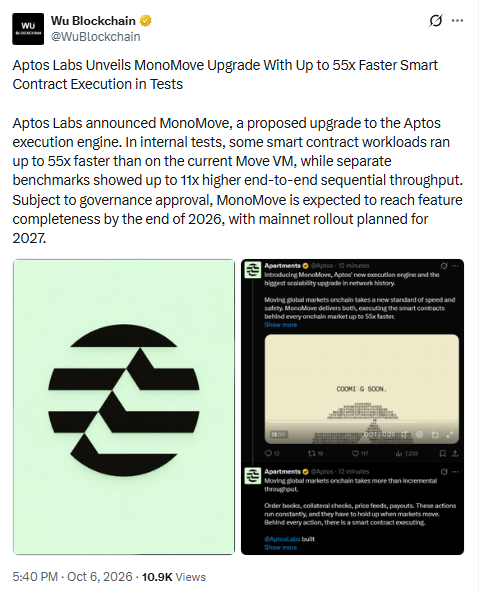
Aptos has introduced MonoMove, a proposed redesign of its smart-contract execution engine that Aptos says can process some onchain workloads up to 55 times faster than its current system.
The upgrade targets the virtual machine (VM) that executes code inside transactions, with testing focused on workloads from Decibel, an onchain exchange incubated by Aptos Labs. The performance improvements differ substantially depending on the particular transaction type, while comprehensive end-to-end testing resulted in performance gains of around 3x to 8x.
The difference between these two matters since the 55x improvement doesn’t mean Aptos network has improved its throughput performance by 55x. MonoMove is only concerned with the execution speed of the execution engine for smart-contract code.
What Is Aptos MonoMove?
Aptos MonoMove is a new execution engine designed to replace the existing Move virtual machine rather than simply tune its current implementation. The project focuses on reducing the work required to execute individual instructions while also developing support for more advanced parallel processing.
Source: Wu Blockchain
The system architecture is based on two main technical approaches, monomorphization of micro-ops and a register-based interpreter.The idea of monomorphization is to prepare specialized code versions prior to running the program. This will make it impossible for the engine to see certain data types while running the transaction.
A register-based interpreter works in a different way when working with values. Instead of popping and pushing the values on the stack all the time, it works with named slots holding values.
MonoMove has already been integrated into the Aptos block executor, the component responsible for processing transactions within blocks. The development process, nevertheless, continues, and more features are still being added.
Aptos Reports Different Gains Across Workloads
The strongest MonoMove performance figure comes from internal testing rather than an independent benchmark. Aptos replayed real mainnet transactions from Decibel and compared their execution using MonoMove with the previous VM.
The performance varied based on the type of transaction.
| Type of Transaction | Performance Improvement |
| Collateral withdrawals | Upto 55 times |
| Vault requests | Upto 40 times |
| Perpetual market requests | Upto 38 times |
| Order placements | Upto 22 times |
The testing was also conducted for other end-to-end workloads. Aptos reported throughput improvements ranging from approximately 3x to 8x. Order-book matching improved by about 7x, while liquidity-pool swaps improved by roughly 5x to 7x. Lending markets were also included among the tested workloads.
However, smart contract execution is just the first phase of transaction execution. Consequently, a huge improvement in the execution engine does not mean an equal gain in terms of blockchain scalability.
Why the Execution Engine Matters
The workloads used for testing are closely connected to onchain markets. Collateral withdrawals, vault requests, perpetual-market activity and order placements all involve smart-contract execution.
MonoMove is therefore being developed with computationally demanding financial activity in mind. Its design has two related performance objectives. The first is improving how quickly a single processor core handles a job. The second is increasing parallelism so compatible jobs can be processed alongside one another.
Aptos previously reported roughly 2x gains from Loader V2 in 2025. The 3x-to-8x end-to-end improvements reported in MonoMove testing provide a separate measure of the newer system’s performance, although the results come from internal tests and specific workloads.
MonoMove Is Still Under Development
MonoMove is not yet live for users. Aptos’s development plan moves through stages, beginning with sequential execution before progressing toward more advanced parallel support.
Several components remain to be completed, including native function ports, reentrancy checks and gas instrumentation. Reentrancy checks address a class of smart-contract vulnerabilities in which a contract can be called again before its original operation has finished. Gas instrumentation measures computational usage so transactions can be charged according to the resources they consume.
Aptos is targeting completion of the full feature set by the end of 2026. A mainnet rollout is planned for 2027, but that deployment remains subject to governance approval.
Testing Will Be Critical Before Mainnet
Aptos has outlined differential testing and formal verification as part of the effort to ensure MonoMove behaves consistently with the legacy AptosVM.
Differential testing is essentially giving both engines similar inputs and checking for differences in their outputs. Formal verification is a mathematical method of proving that certain aspects of an implementation work as expected.
The project is also intended to remain within Move’s resource-oriented safety model while adding runtime checks.
For now, the 55x figure should be understood as an upper-end result from internal testing of specific replayed transactions, rather than a universal performance guarantee. Production results could differ once the remaining features and their associated overhead are incorporated.
FAQs
What is Aptos MonoMove?
Aptos MonoMove is a redesigned execution engine intended to process Move smart contracts more efficiently than the existing execution system.
Is MonoMove currently launched?
No. MonoMove is still in the developmental stage, with Aptos aiming at finishing all its features by the end of 2026, and launching on the mainnet in 2027.
Is MonoMove making Aptos 55x times faster?
No. Not throughout the whole blockchain. Aptos achieved 55x faster speed on certain transactions, while overall tests showed only 3x to 8x improvement in the speed.