
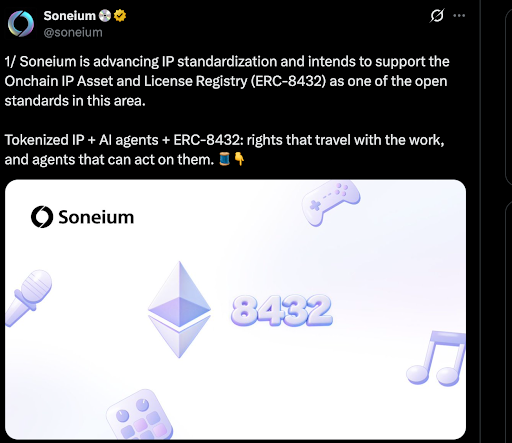
Soneium is planning to support ERC-8432, a proposed Ethereum standard focused on intellectual property and licensing on the blockchain.
The Sony-backed network said Tuesday that the standard could help AI agents and other applications identify digital content and check the rights attached to it.
ERC-8432 provides a common format for registering tokenized IP and licensing agreements onchain. That could be useful as AI tools increasingly create, modify and reuse digital content.
Source: X
At the moment, ownership and licensing information can be spread across contracts, databases and different platforms. Applications may have no simple way to check whether a piece of content can be used.
ERC-8432 is intended to provide that information in a format that software can read.
ERC-8432 Focuses on IP and Licensing Information
The proposal allows independent registries to identify tokenized IP assets and publish their licensing terms.
Licensing agreements can also be recorded onchain. Applications can then check those records rather than relying on a single platform to provide the information.
The records can include a chain ID, registry and asset ID, which help identify where a particular asset is registered.
ERC-8432 does not create ownership rights or determine how an asset should be licensed. It is a technical standard for accessing rights information.
That difference is important for AI applications.
An AI agent might find a song and know who owns it, but that does not tell the agent whether it can use the song in a video. The licensing terms are a separate issue.
With ERC-8432, an application could check those terms before using the content.
AI Agents Could Check Content Rights
One possible use would be an AI system checking a license before using a piece of content.
For example, an AI video tool could find a recording and check its registered terms. If the intended use is allowed, the application could proceed. If a license is needed, the agent could potentially complete the agreement through an onchain transaction.
The application could then verify the transaction before using the recording.
Developers could also use the same standard across different registries. That could reduce the need to build separate integrations for every platform storing IP information.
Marketplaces and other AI applications could use the system as well.
But adoption remains a major question. Rights holders would need to register their works, while registries, developers and AI platforms would need to support ERC-8432.
Without that support, applications would still have to rely on existing licensing systems.
Soneium Continues Its Entertainment Push
Soneium’s move comes as the network continues to build around entertainment and other blockchain use cases.
In April, Soneium and Plume Network announced a partnership focused on tokenized real-world assets.
The integration uses Plume’s SkyLink interoperability layer to connect assets and yield across different blockchains. The companies said Soneium users could access products linked to tokenized U.S. Treasuries and private credit through Plume’s infrastructure.

Source: X
Plume is an Ethereum-compatible Layer 2 focused on real-world asset tokenization. Its testnet had more than 18 million wallets, according to the source.
Soneium launched as Sony’s public blockchain platform and has focused heavily on entertainment-related applications.
That also gives the network a natural connection to intellectual property. Sony operates across music, film, gaming and other entertainment businesses where ownership and licensing are important.
The Standard Is Still in Development
ERC-8432 remains a draft and is open to feedback from the Ethereum community.
Soneium’s support does not mean the standard will become widely adopted. Other registries, applications, AI developers and rights holders would still need to use it.
There is also a limit to what the standard itself can solve. ERC-8432 can make rights information easier for software to access, but it does not determine whether that information is accurate or legally valid.
For now, the proposal is aimed at a simple problem: AI systems can find digital content much more easily than they can determine whether they have permission to use it.
ERC-8432 would give those systems a standard way to look up that information. Whether it gains traction will depend on how many creators, registries and applications decide to support it.