- Blast will wind down its Layer 2 as operating costs exceed revenue, and users must move assets soon.
- Withdrawals will pause during the Lido exit, then resume after a 24-hour delay for users thereafter.
- Users can withdraw through Blast’s normal interface until October 26, then use its bridge contracts.
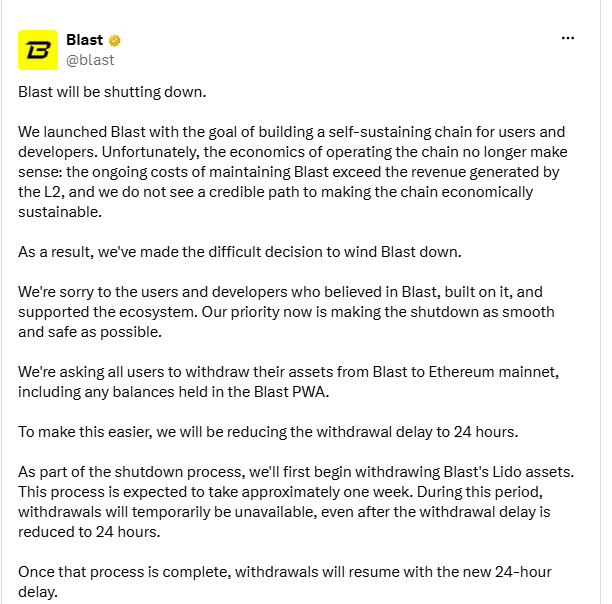
Blast will wind down its Ethereum Layer 2 network after determining that the cost of maintaining the chain exceeds the revenue generated by its operations. The project announced the decision on Oct. 2 and asked users to move assets, including balances held in the Blast PWA, to Ethereum mainnet.
The Blast shutdown will include a temporary pause in withdrawals while the project exits its Lido holdings. That process is expected to take about one week. Afterward, withdrawals will resume with a 24-hour waiting period and remain available through Blast’s regular interface until Oct. 26, 2026.
The Oct. 26 date applies to the normal withdrawal interface rather than the permanent recovery of assets. After the deadline, users will still be able to withdraw through Blast’s bridge contracts deployed on Ethereum Layer 1. Blast said it will provide instructions for that process before the deadline.
Blast Shutdown Follows Rising Network Costs
Blast said the decision followed a review of the economics of operating the Layer 2 network. According to the project, its continuing maintenance costs are now higher than the revenue produced by the L2.
Source: BLAST
The team said Blast was originally created with the objective of building a chain that could financially support its operations while serving users and developers. It concluded that there was no credible route to making the network economically sustainable.
Blast apologized to users and developers who had used, built on or supported the network. It said its priority during the Blast shutdown is to make the process as smooth and safe as possible.
The network launched in November 2023 with $20 million investment from Paradigm and Standard Crypto, Blast had already amassed more than $2 billion in TVL among about 200,000 early adopters prior to its mainnet launch in February 2024.Its TVL has since fallen substantially.
According to DeFiLlama data cited in the supplied reporting, Blast now has slightly more than $32 million in TVL. The BLAST token also fell 17% on Friday, bringing its market capitalization to about $23 million.
Users Have Until October 26 Through the Regular Interface
The withdrawal process will begin with Blast handling assets it holds through Lido. The project expects that stage to last roughly one week, and withdrawals will be unavailable while it is underway.
Blast also plans to shorten the withdrawal waiting period to 24 hours. The shorter period will not take effect for users while the Lido withdrawal process is still in progress.
Once the Lido exit has been completed, withdrawals will reopen under the new 24-hour waiting period. Users will then be able to use the standard Blast interface until Oct. 26.
The project has asked users to transfer their assets to Ethereum mainnet. The request applies to assets held on Blast as well as balances stored in the Blast PWA.
Users who do not complete the process through the standard interface before Oct. 26 will not lose the ability to access their assets under the announced plan. Instead, they will have to interact directly with Blast’s bridge contracts on Ethereum L1. Blast said detailed instructions will be released before the interface deadline.
Previous Changes Within the Blast Ecosystem
The Blast shutdown follows other changes involving projects and infrastructure associated with the network.
In May 2025, Blast ended its Safe integration, citing third-party risk and usability concerns while preparing its own multisignature wallet solution. Users who had accessed their multisignature wallets through Safe’s interface were directed to BrahmaFi’s hosted interface or could host their own.
Blast also said at the time that it planned to add multisignature functionality to Blast Mobile.
Another project in the network’s history, Fantasy Top, announced its closure earlier this year. According to the reporting supplied for this article, the project said it would refund pre-seed and seed investors dollar for dollar. It also reported returning about $20 million to its community through ETH, BLAST, and player-related rewards.
Pacmoon, previously described as Blast’s largest meme coin by market capitalization, also left the network. In August 2024, its team announced plans to migrate to Solana and adopt the ARMY name there. The owners of the existing PAC coins were told to burn them before Aug. 14, in order to be eligible for the ARMY airdrop.
According to the IRS, for American users, transfers of digital currencies to other wallets, addresses, or accounts controlled by the same person are usually not taxable.