

The Hyperliquid MiCA Feedback submission was made to the European Commission on October 1, 2026, following the review of the Markets in Crypto-Assets Regulation by the European Union by the Hyperliquid Policy Committee (HPC).
Moreover, it is recommended by the committee that the European Union makes use of existing financial rules when regulating on-chain perpetuals, besides accepting blockchain-verified data and not imposing any market-related limitations.
MiCA Review: Looking at the EU’s Crypto Regulatory Framework
The European Commission has started its targeted consultation on May 20, 2026, on whether MiCA is still fit for purpose after its adoption and evolution in crypto marketplaces. This is a consultation on both legal and technical aspects that would be used for drafting the review report according to MiCA, which might result in legislative amendments if found necessary by the Commission. The deadline has been pushed to September 30, 2026.
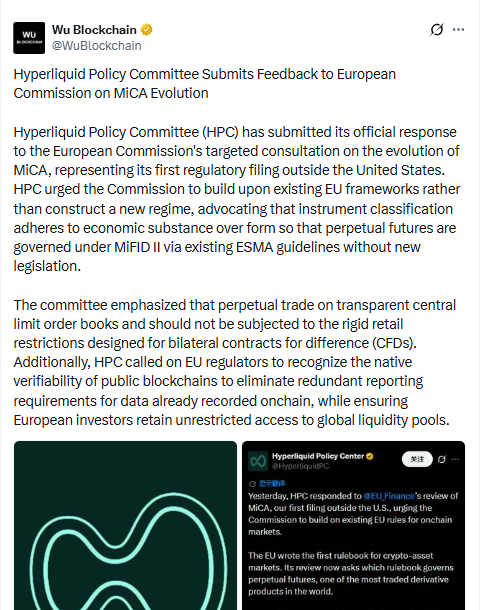
Source: Wu Blockchain
MiCA established a uniform regulatory framework for crypto-assets and crypto services within the EU. In addition crypto-assets, which could be considered as financial instruments, were not regulated by MiCA but were included in other financial market regulations, including MiFID II.
Hyperliquid MiCA Feedback Focuses on Existing MiFID II Rules
HPC argued that regulators should classify financial instruments according to their economic substance rather than their technological form. Its submission calls for onchain perpetual contracts to be addressed through the existing MiFID II framework and ESMA guidance rather than through a separate legislative regime. Reports describing the submission identify this as HPC’s first regulatory filing outside the United States.
The proposal builds on an existing ESMA position. In guidelines published in December 2024, ESMA said perpetual futures are derivative instruments even though they do not have an expiration or settlement date.
Perpetual futures have been requested by ESMA to be assessed with respect to the classification of derivatives in Section C, points 4-10 of Annex I of MiFID II.
HPC Distinguishes Onchain Perpetuals From CFDs
A major part of the submission concerns how perpetual contracts are traded. HPC argues that perpetuals matched through public central limit order books differ from traditional contracts for difference, where the market structure can involve a provider acting as the counterparty.
The committee therefore says CFD-specific retail restrictions should not automatically be applied to onchain perpetuals simply because both products provide leveraged price exposure.
Nevertheless, ESMA’s own recent guidance serves as a good counter example. ESMA pointed out in February 2026 that some products classified as perpetual futures and perpetual contracts would qualify for the CFD intervention regime due to their nature.
The regulations for CFDs could include restrictions on leverage, risk warning provisions, close-out procedures for margin and protection against negative balances.
The regulation, thus, is not whether all perpetuals will be regarded as CFDs or will be exempted from CFD rules. The question is whether the unique features of these products merit such classification or not.
Onchain Data Could Reduce Duplicate Reporting
HPC also asked EU regulators to recognize the native verifiability of public blockchains. Its proposal requires regulated companies not to submit duplicate reports when the information regarding the underlying transactions is available in the public domain and can be independently verified through the blockchain.
The proposal may gain relevance as regulators try to figure out how their traditional reporting mechanisms could be applicable to blockchain-based market systems. Public ledgers may offer a different type of transaction records as compared to those offered by the databases maintained by conventional financial intermediaries.
Hyperliquid’s Market Activity Shows Why Perpetuals Matter
The regulatory discussion concerns a market that has grown well beyond a niche trading product. DeFiLlama reported about $209.6 billion in Hyperliquid perpetual volume over the 30 days ending around the start of October, with an open interest of roughly $8.2 billion.
DeFiLlama defines perpetual volume as the notional value of trades, including leverage, while open interest measures outstanding derivative positions.
CoinGecko’s exchange data likewise identifies Hyperliquid as a decentralized perpetual-futures exchange operating on its own Layer 1 network. This data proves the fact that the platform offers hundreds of perpetual markets, which is why its classification has an impact on more than one token or trading pair.
Additionally, the policy discussion surrounding regulation does not solely concern Europe. In the United States, both SEC and CFTC have been evaluating the applicability of current derivatives definitions to new market structures.
The June 2026 joint request for comment has sought opinions on updating and aligning the derivatives definitions, apart from other U.S. regulators dealing with perpetual contracts.
Global Liquidity Remains a Central Regulatory Issue
HPC also urged European regulators to preserve investor access to global liquidity pools. According to the committee, regulation must not unnecessarily fragment markets but at the same time ensure investor protection.
However, for the regulators, these are critical factors to consider. More restrictions will be able to solve the problems of leverage and investor protection, while differences in regulations from one place to another will be able to influence the location of market activity and liquidity. The consultations by the European Commission intend to do just that.